Senior horses often develop dental issues as they age. In this podcast episode, veterinarian and equine dentist Dr. Jack Easley talks about the types of dental issues senior horses can develop. (You can learn more about Easley in the “About” section below.)
Hypsodont Teeth in Horses
Easley said horses are unique as a species because they eat a forage diet high in biological silicate (which is a major component of the rocks on earth). This means the grasses they eat have a lot of silicon in them. “That is abrasive to teeth, so it tends to wear the teeth down over time,” explained Easley.
He said because of this—and because horses live to be older than most herbivores—their teeth have to last longer.
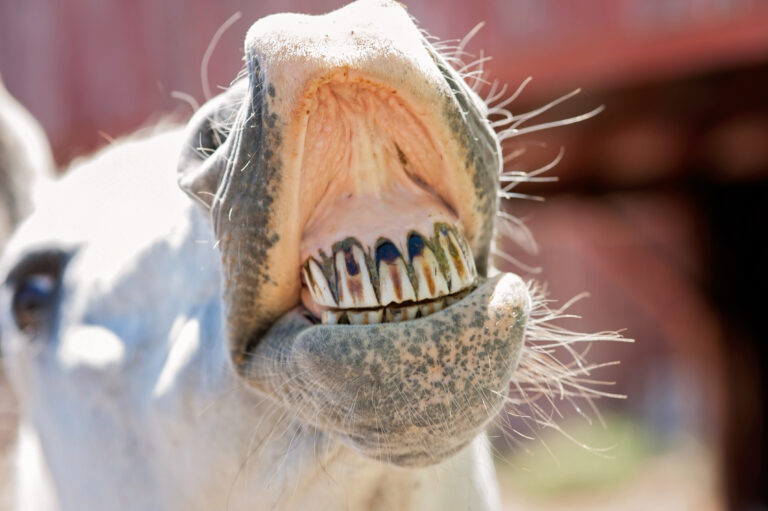
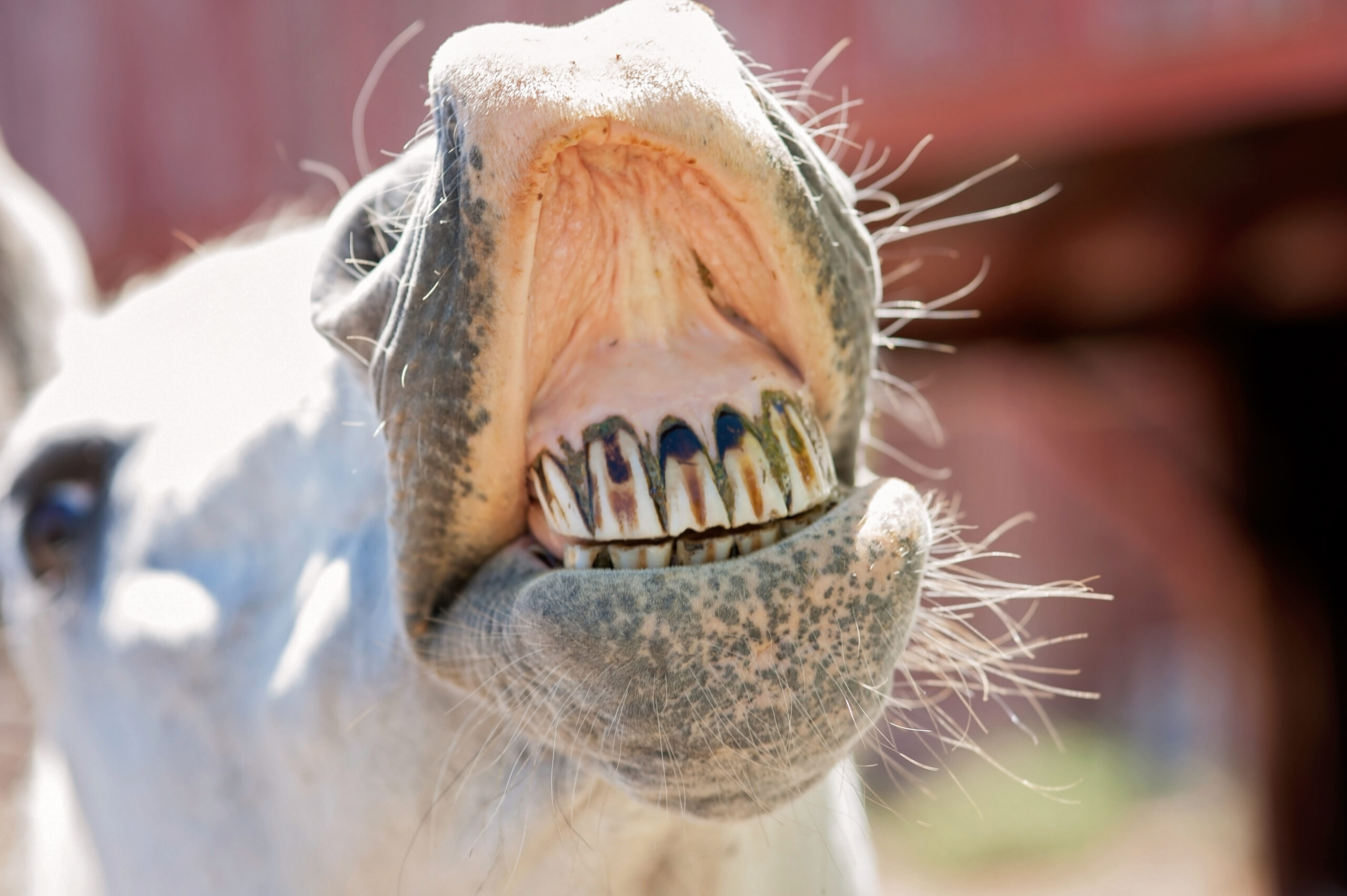
“They have evolved to have what are called long-crowned teeth or hypsodont teeth,” Easley explained. “And these long-crowned teeth continue to erupt throughout the horse’s life. The occlusal surface of the teeth wear down.”
The tooth erupts into the mouth in a young horse. By the time a horse is about five years old, it has 4.5-inch-long molar and incisor teeth.
“Most of that tooth is composed of crown, which is the enamel-containing portion of the tooth,” said Easley. “The roots tend to continue to elongate over the horse’s life, but as the tooth erupts and wears down, it wears the crown of the tooth down.”
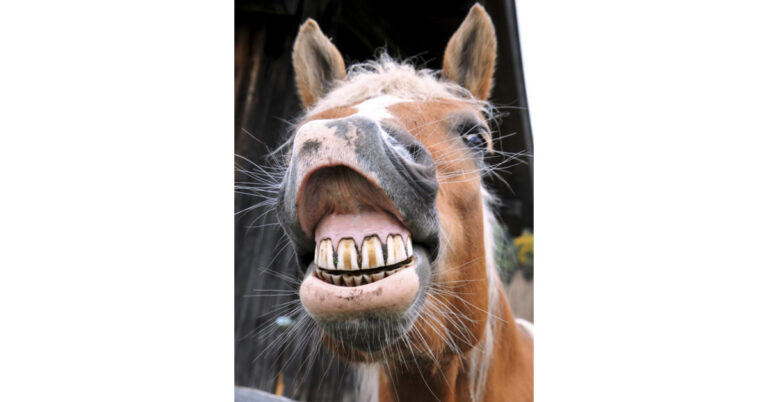
He explained that the crown is the hard part of the tooth that has sharp edges to grind forage. “So, as the horse ages, the crowns get shorter, and they have less enamel on their teeth,” he said. That makes the horse less able to masticate and chop up forage.
Horse Teeth Wear Out
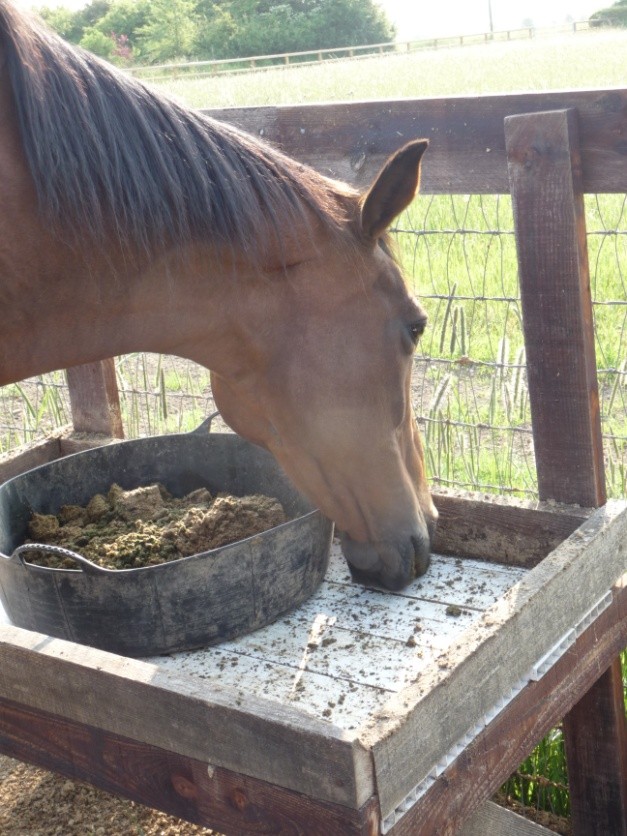
As horses reach their 20s and 30s, “their teeth finally begin to wear out to where the horse is now masticating on the root part of the tooth that doesn’t contain any enamel,” said Easley. “Those are what we refer to as ‘smooth mouth’ horses. And those horses can no longer chop up forage, so we have to manage their diets and take care of them a little bit better.”
To recap, hypsodont teeth continue to elongate throughout a horse’s life. “They reach their maximum size when the animal is about four to five years of age. Then they get shorter every year by 4 to 7 millimeters throughout the horse’s life. So, by the time the horse is in its 20s, these teeth are beginning to wear out.”
Periodontal Disease
Easley said this is a disease of the support structure of the tooth. “With horses, they have a really active support structure for that tooth,” he noted. “The tooth sits in a dental socket, but remember that tooth is continuing to erupt throughout the horse’s life. So, the dental socket is remodeling, and a different portion of the tooth is erupting up into the mouth.”
The periodontal structure keeps the tooth pushed up into the mouth and keeps the teeth wearing at an even rate. “If anything happens to interrupt that, then the horse can get gingivitis and periodontal pockets,” said Easley.
The most common cause of periodontal disease is when a horse develops little gaps between its teeth called diastema. “They get food trapped into those gaps, then the food tends to stagnate and get rotten down in those pockets between the teeth,” described Easley. “Then the gum recedes and the bone recedes and the periodontal tissues get infected. It’s a very painful condition.”
Easley said it is common in older horses due to the continual wear and eruption of teeth. “And sometimes these teeth don’t stay in perfect alignment,” he added. “Then they tend to get pockets between the teeth that trap food.”
He said periodontal disease is much more common in older horses than younger horses. “Probably in 90% of the horses over 20 we see at least one periodontal pocket in their mouths,” he noted.
Managing Periodontal Disease
“You’ve got to consider that a horse’s got 44 teeth,” said Easley. “So, when we talk about a horse with periodontal disease, that can just be one of 44 teeth. The incidence per tooth is pretty low.
“But when you’ve got 44 teeth, you’ve got a pretty good chance of having one of them have a problem,” he noted.
Easley said periodontal disease can be managed in the early stages, but it does have to be continually managed. “We usually don’t treat periodontal disease one time and that takes care of it,” he stressed. “Usually it’s a management problem from then on, and it does require regular either semi-annual or annual checkups and having these pockets cleaned out to keep the horse comfortable and keep the gums healthy. And if it goes on too long, then the horse ends up losing a tooth.”
Do Horses Get Cavities?
“They do!” stated Easley. But, they get a different type of cavity than people get.
“In our teeth, we have what are called brachydont teeth, so the crown of our tooth is covered with enamel. In a horse, the enamel is sort of more to the inside of the tooth. The crown of the tooth is actually covered in cementum.”
The cementum can get carious lesions [cavities], explained Easley.
He said there are two different types of carious lesions in horses, and both of them are more rare than periodontal disease. “But, probably 10% of the older horses that we see” have carious lesions [cavities].
Peripheral Cavities
“There are peripheral caries that get around the outside of the tooth and can dissolve the cementum and the enamel and actually get into the dentin and cause an infection in the tooth. And this is usually caused from a change in pH in the mouth,” Easley said.
He said pH changes can be caused by acidic feeds, such as silage, or by water that has a really low, acidic pH. “There are certain parts of the world that have acidic water, and they’ll cause peripheral caries in horses.”
This is usually manageable by changing the diet or water source.
Cavities in the Crowns
A different type of carious lesion involves the infundibulum (a depression in the crown of the upper cheek teeth and incisor teeth).
The infundibulum can become carious and can kind of dissolve the middle of the tooth, explained Easley. That can lead to both endodontic disease or an infected tooth.
“It can weaken the tooth to where the tooth fractures,” said Easley.
Other Issues
Other common dental issues in older horses include broken or chipped teeth, tooth loss, and malaligned teeth, usually due to tooth loss or periodontal disease.
Horses can also have soft tissue issues in their mouths, including infections and tumors.
“There’s a very thin layer of bone and soft tissue that separates the root of the tooth from the floor of the sinus,” said Easley. “And, as old horses get deep periodontal pockets or fracture a tooth or get an endodontic infection, it’s not unusual for those to then migrate into the sinus and cause a secondary sinusitis.”
That can cause the horse to have a runny nose or a smelly nasal discharge. “Some of these deep periodontal pockets will actually allow food to get into the sinus,” described Easley. “Then you’ve got not just an infection, but a sinus contaminated with forage. And those things are hard to manage. They’re much easier to prevent than they are to treat them once they happen.”
Clinical Signs of Dental Disease in Senior Horses
Easley talked about clinical signs of dental issues in horses. He encouraged owners to contact their veterinarians if they notice these signs, which include:
- losing weight
- eating more slowly than usual
- dropping hay or feed during chewing.
Easley said most horses that have been diagnosed with dental disease by a veterinarian do not show clinical signs that have been detected by an owner or trainer, even when disease is severe.
“But once we find the problem, it’s amazing sometimes how much better these horses get once they get the dental problem taken care of,” stated Easley. “Because horses are a prey animal, they don’t exhibit pain or discomfort or anxiety as well as a lot of other animals or people do. They can’t tell you when they hurt, and they try not to show it.”
He said all horses need to have their teeth examined at least once a year.
About Dr. Jack Easley
Dr. Jack Easley is a veterinarian and a boarded equine dentistry specialist. Easley strived for more than 20 years to create a specialty board for equine dentistry. Then, in 2013, Easley and 18 colleagues from around the world passed the first boards given to 24 veterinarians. He received Diplomate status in the spring of 2014. That is when the American Veterinary Dental College Equine Specialty was formally recognized by the American College of Veterinary Dentistry and the AVMA.
Further Content
- My Senior Horse Podcast: Dental Care. Kimberly S. Brown with Dr. Jack Easley. MySeniorHorse.com
- Tips on Feeding Older Horses with Dental Issues. Dr. Pat Harris. MySeniorHorse.com
- Help! My Senior Horse is Losing Weight! Dr. Nettie Liburt. MySeniorHorse.com
- 10 Tips for Feeding Forage to Horses. Dr. Pat Harris. MySeniorHorse.com
Sign up for My Senior Horse’s FREE newsletter to get the latest information about equids 15 years and older delivered straight to your inbox!