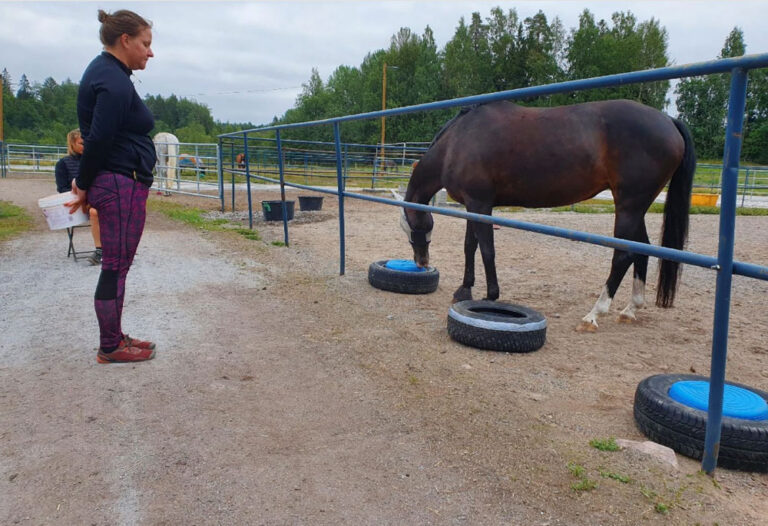
Environmental enrichment is important for horses’ physical and mental health. This is especially true for animals that are stabled or even kept in stalls with adjacent run-in pens. Recent research compared how different enrichment items (hay feeders, activity balls, and mirrors) affected horse behavior and physiology.
The Research
The study used nine Quarter Horses—six geldings and three mares. They had an average age of 11.33 years and a 5.5 body condition score (on a 1-9 scale). All horses were individually housed in stalls with an attached dirt paddock and bedded with pine shavings.
The healthy horses were active members of the University of California Davis Division 1 Women’s Equestrian Team. They are part of the National Collegiate Equestrian Association (NCEA).
This study examined the aforementioned stabled horses that were provided environmental enrichment in the form of hay feeders, activity balls, or mirrors across randomized trials. Each trial included 30 minutes of observation, four times per day. Researchers removed enrichment between sessions. There was a 5-day washout between trials.
Nightwatch Smart Halters recorded heart and respiration rates. Behaviors were video-scored using instantaneous scan sampling. Observers were not blind to the treatments. Researchers tested enrichment effects, item type, time of day, and possible interactions.
Study Results
There were no significant differences in interaction behavior, so all three environmental enrichment items appeared equally engaging to the horses.
In contrast, Jørgensen et al. found that horses in individual paddocks performed more item-directed behaviors toward edible items than non-edible items. Bulens et al. found that while Jolly balls appeared as equally interesting as ropes, both had limited item-related behavior and had no effect on normal or abnormal behaviors of stabled horses.
Those researchers concluded that non-edible items are not useful enrichment items for appropriately reared horses.
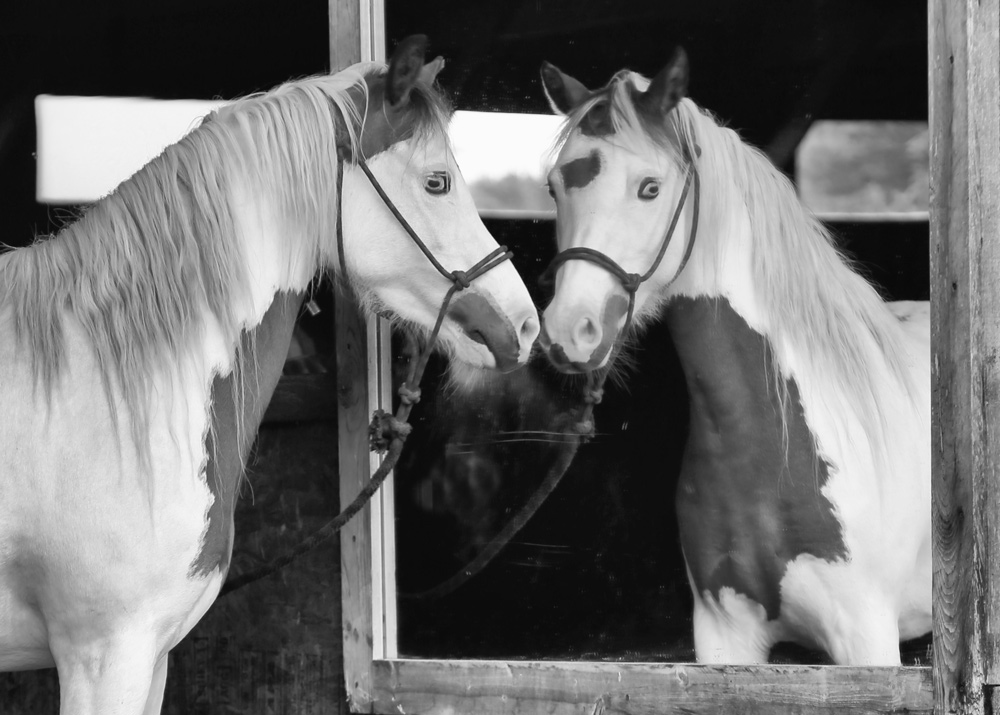
In the recent study, however, all environmental enrichment items had similar interaction times and significant differences in heart rate and behavior from the control. “Thus, we argue that non-edible items such as activity balls and mirrors should be considered effective enrichment,” noted the researchers.
Why Enrichment Is Important
The researchers said that compared with free-roaming horses that graze for 50%–60% of the day and stand for 20%–35% of it, stabled horses spend more time standing (40%–58%) and less time eating (36%–47%).
“This discrepancy can impair musculoskeletal health and digestion, increasing risk of ulcer development from continuous gastric acid secretion,” said the researchers. “Reduced behavioral expression may also lead to negative subjective feelings such as increased stress and frustration or stereotypical behaviors.”
They said enrichment “seeks to mitigate these risks by providing stimulation that promotes positive experiences, provides opportunity and choice to perform species-typical behavior, and/or mitigates unwanted behaviors that may harm the animal’s well-being.”
In this study, enrichment did not affect respiration rate, but, it increased heart rate, grazing, locomotor movement, and decreased frustration behaviors.
“Effects were stronger during midday when horses did not have routine meal provisions,” noted the research. “In our study, the hay feeder had stronger effects, although all items were effective enrichment and could be provided to improve the behavior, health, and welfare of stabled horses.”
Find the Study
The study was titled “Physiological and Behavioral Responses of Stabled Horses (Equus caballus) to Three Types of Environmental Enrichment.” It was authored by Miranda Brauns, Animal Biology Department, University of California Davis; Ahmed Ali, Animal and Veterinary Sciences Department, Clemson University; Jeannine Berger, Sacramento Veterinary Behavior Services; and Amy McLean, Animal Science Department, University of California Davis. It was published in Animals in September 2025.
This article belongs to the Special Issue Recent Advances in Equine Behavior and Welfare.
Further Content
- Horse Toys for Environmental Enrichment. Kimberly S. Brown. MySeniorHorse.com
- Boredom Busters: Horse Toys. Dr. Nancy S. Loving. MySeniorHorse.com
- Proactive Planning for Horse Retirement. MySeniorHorse.com
- Are Stall Toys Good for Horses? Nancy Diehl, VMD. TheHorse.com
- Which Toy Would Your Horse Enjoy? EQUUSmagazine.com
- How to Make a Dry Lot Your Horse Will Love. Hope Ellis-Ashburn. EQUUSmagazine.com
- Equine Stall Confinement Tips. Dr. Nancy Loving. MySeniorHorse.com
- My Senior Horse Podcast: Positive Reinforcement. Dr. Eleanor Girgis. MySeniorHorse.com
- Feel-Good’ Horse Touch, Such as Scratching. Dr. Sue Dyson. MySeniorHorse.com
- Horses and the Science of Contentment. Dr. Sue Dyson. MySeniorHorse.com
- My Senior Horse Podcast: Horses and the Science of Harmony. Dr. Sue Dyson. MySeniorHorse.com
- My Senior Horse Podcast: Equine Behavior. Dr. Kris Hiney. MySeniorHorse.com
Sign up for My Senior Horse’s FREE newsletter to get the latest information about equids 15 years and older delivered straight to your inbox!