
Friends, forage, and freedom are the key prerequisites for a contented horse.1 But, how do you know if your horse’s needs are being satisfied adequately? And what are some potential signs that something is not right?
(Editor’s note: Author Dr. Sue Dyson was executive producer of the film Horses & the Science of Harmony. Dyson, a veterinarian with a PhD, has researched many aspects of equine lameness and behavior. She worked with Padma Video on the above film, and they are now releasing Bonus Footage to help us better understand and manage our horses. You can listen to a podcast with Dyson about Horses & the Science of Harmony.)
Who Are Friends?
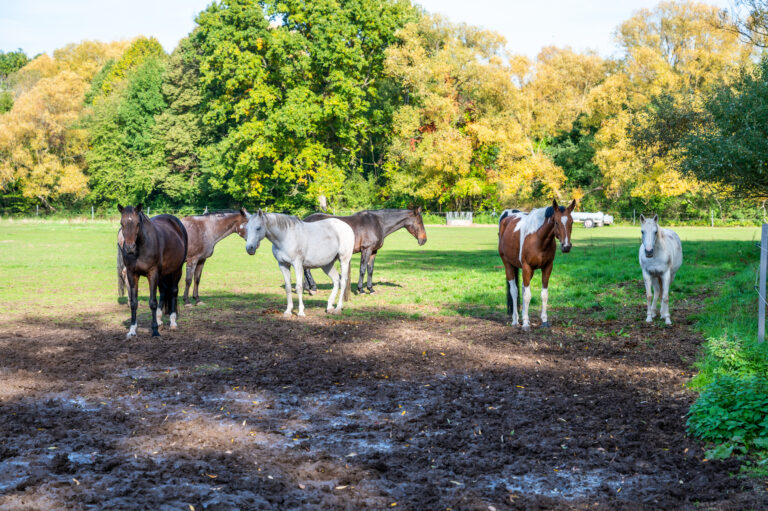
Friends means having access to at least one other horse. That is another horse in easy sight and in a situation so that there can ideally be social interaction, for example mutual grooming.
In a study in which horses that knew each other and were brought in from a field and housed individually, those that were separated by half walls spent more time resting and less time being vigilant than those that were separated by full walls.
However, an aggressive or particularly dominant companion may not be ideal and may intimidate and stress a horse unnecessarily. So, the interactions between horses must be observed, bearing in mind that some horses in normal play may appear rather wild!
Grazing
Horses are natural grazers, eating forage throughout the day and night. This is important for gastric health. However, it is not always that simple.
The type of forage, including its palatability and digestibility, are variants that potentially can influence gastrointestinal function. Inappropriate forage may predispose to impaction colic, for example.
Whether or not a horse is a ‘good doer’ and prone to becoming overweight can influence whether access to forage must be limited, or modified. That might mean, for example, soaking hay for several hours before it is fed.
We need to be sure that if a horse is turned out with others and being fed supplemental hay that the hay piles are well spaced. You might need an extra pile so that a timid feeder does not miss out.
If a horse is not finishing available forage, we must ask why? Is it the taste or smell of the forage? Is it the texture? Or does leftover forage reflect oral discomfort?
Shelter
A recent study demonstrated that horses living out chose to spend time in shelters for an average of three hours per day, usually moving in and out several times. Moreover, somewhat unexpectedly the horses spent more time in a shelter in summer months than during the winter. They entered shelters more often in the afternoon and were resting standing up.
There was considerable variation among horses, indicating that ideally there should be free-choice shelter. That means availability of a shelter when a horse wishes to use it.
Stereotypies
The display of stereotypical behaviours such as box walking, fence walking, windsucking, crib-biting, or weaving are not normal and indicate that something is currently not right in the horse’s management or was not right in the past. That resulted in the development of an habitual unwanted behaviour (for example, wind sucking).
Feral horses may roam up to 20 kilometres daily. We know that daily free exercise (freedom) is important, ideally with or close to another horse.
However, horses are individuals. While turnout for 12 hours a day suits many, there are exceptions. So, if a horse is fence walking, we need to ask why and what can we do to improve the horse’s environment and management.
At Rest
Horses need to be able to rest adequately. That means getting adequate rapid eye movement (REM) sleep.
Although horses can sleep standing up, they can only achieve REM sleep when lying down. If a horse shows no signs of having been lying down (mud on the body, shavings or straw in the tail) and is seen to repeatedly knuckle forward on the forelimbs when dozing standing up or has abrasions on the front of the fetlocks or carpi (knees), we need to ask why?
The most common cause is chronic pain. However, consideration should also be given to something in the external environment that stimulates the horse to remain vigilant, for example not being able to see another horse.
Human Interaction
Most horses want to interact with people so they will approach a person with an engaged expression and attentiveness. They are seeking a reaction.
If a horse stands in the back of a stall and pays no attention to someone entering, that is an indicator that something is not right. The reason needs to be discovered.
Likewise, most horses stand with the head and neck above the position of the withers unless resting. An abnormally low head and neck posture usually indicates a problem.
However, some breeds—such as Friesians and Purebred Spanish horses (PREs)—are remarkably stoic and might conceal signs of discomfort. They might show only subtle changes of behaviour.
A 24-hour video surveillance study demonstrated that some horses conceal signs of pain in the presence of a person, but might behave abnormally when alone.
Therefore, it is important that you know your horse and are attentive to any slight changes from normal behaviour, which could reflect lack of contentment.
Reference
- Lansade, l., Lemarchand, J., Ruet, A. Shelter use in horses: time spent indoors and factors of variation – results from a one year longitudinal study. Applied Animal Behaviour Science, (2025). doi:https://doi.org/10.1016/j.applanim.2025.106699
Further Reading
- My Senior Horse Podcast: Positive Reinforcement. Dr. Eleanor Girgis. MySeniorHorse.com
- My Senior Horse Podcast: Horses and the Science of Harmony. Dr. Sue Dyson. MySeniorHorse.com
- The 24 Behaviors of the Ridden Horse in Pain: Shifting the Paradigm of How We See Lameness. Dr. Sue Dyson with Padma Video.
- Horse Behavior During Tacking and Mounting. Dr. Sue Dyson. MySeniorHorse.com
- Ridden Horse Performance Checklist: Behaviors in Ridden Horses that Might Signify Discomfort. Dr. Sue Dyson. MySeniorHorse.com
- How An Uncomfortable Horse Might Feel to a Rider. Dr. Sue Dyson. MySeniorHorse.com
- Meet Snow White: A Senior Shetland Pony. Alex Beckstett. MySeniorHorse.com