Many senior horse owners will have to deal with equine vision loss or blindness in their animals. In this podcast, veterinarian and equine eye expert Dr. Ann Dwyer explains the science behind equine vision loss and offers management tips. (Learn more about Dwyer in the About section below.)
Dwyer recently completed a chapter in the 5th edition of Gilger’s Equine Ophthalmology, which is considered the leading eye reference for veterinarians. Her chapter focused on the management of blind horses.
In a previous version of that book that is available for download, Dwyer stated: “Some horses adapt poorly and must be euthanized to protect the safety of their handlers and themselves. However, others show a remarkable ability to adjust to blindness. Adaptation to blindness depends on the inherent temperament of the horse, the dedication of the owner, and the presence of a safe and predictable environment.”
(Editor’s note: The content of this podcast is the expert’s approach to the topic. Please consult with your practitioner if you have questions.)
How Do Horses Adapt to Vision Loss?
Dwyer said horses that lose vision gradually can adapt fairly quickly, usually within several days. A horse that suddenly loses vision can take several weeks to adjust. During this time, management is critical.
At first, the blind horse might run into things, tilt its head, become spooky, circle, freeze in place, neigh, and act anxious. Dwyer said owners have to manage these horses specifically for their vision loss.
She recommended blind horses be removed from a herd setting. “The herd will sort of reject the blind horse. They may injure it or not allow it access to food,” explained Dwyer. “It’s much better to actually support that horse with a calm environment and a safe, quiet enclosure away from the herd. A single, quiet, sighted companion can help.”
You have to allow the newly blind horse time to settle into a safe location. Dwyer said you shouldn’t do any training during the adaptation. “Just make life as easy as possible,” she said.
“You need to blind-proof the environment, and you need to make sure the stalls are free of hazards. Run your hands over the boards to make sure there are not nails or pieces of wire sticking out, and make sure stall doors and walls are secure.”
Dwyer emphasized safe board, pipe, or mesh fencing, not barbed wire or single strand electric fence. Dwyer said they will eventually learn to avoid the fence perimeter and respect fences with a strand of wire along the top plank, but the blind horse can get into a lot of trouble if it doesn’t know the fence is there.
Try to reduce spooky stimuli. “Post signage that there is a blind horse so visitors are warned appropriately,” she noted.
‘Guide’ Horses
Dwyer said most successful guide horses have quiet temperaments. Having a bell on the guide horse’s halter is a great help. She said owners often pair a full-sized blind horse with a quiet mini or pony.
She said it is amazing that many times the guide horse appears to understand its role. “I’ve seen them lead the blind horse through the gate and help it get food,” said Dwyer. “The bond is really strong.”
Some sanctuaries that house blind horses house two or three blind horses together with no sighted horse, said Dwyer. “They know their environment and are happy together,” she said.
Once Adapted
Once blind horses are fully adapted, Dwyer said you should train the horse to do all the things that might be needed. This includes loading and unloading from a trailer. She suggested taking the blind horse for a ride in case you have to take the horse to the vet in the future.
Dwyer said there are many more tips and photos on blind horse management in her downloadable chapter.
Compensating for Blindness
The blind horse’s intact senses—especially hearing and touch—will be rerouted in their brains. Over time these senses become enhanced, she noted.
“The other think that is amazing to watch is that adapted horses will develop a mental map of their environment,” Dwyer said. “They are often mistaken for sighted horses because you will see them galloping across a pasture and stop a little short of the fence. They know their environment.”
However, Dwyer did caution that some horses that had anxious temperaments and become blind never adapt. “They become dangerous. Those are horses that hard decisions have to be made for,” she said.
Hard Decisions
“The adaptation period is not eternal; it is just a few weeks,” said Dwyer. “If you unsure about what to do, you need to provide a safe environment for that horse for up to eight weeks. During that time, common sense comes into play.”
Use of One-Eyed or Blind Horses
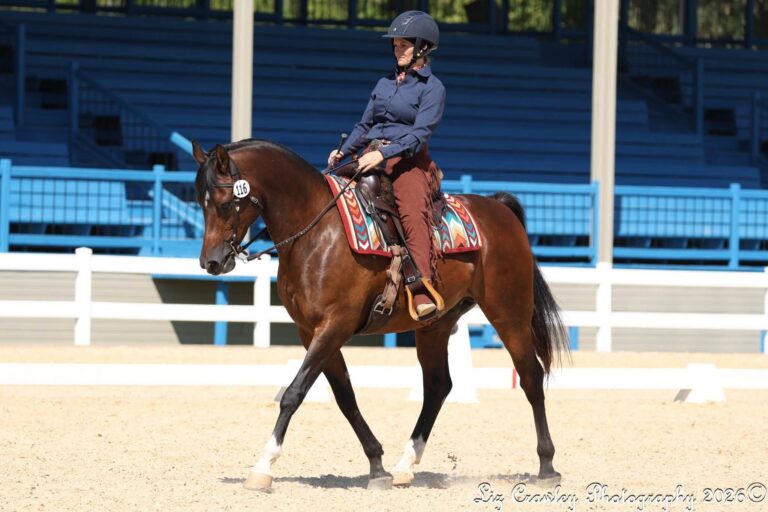
“The one-eyed horses are really common in the world,” said Dwyer. “I’m here to tell you that they can do about anything. Sports records will affirm that. There have been one-eyed horses in the Kentucky Derby. (Patch ran in 2017.) They can hunt. They can do combined training, show jumping, western events, trail riding, and work in equine assisted therapy programs.
“We don’t know that much about equine vision,” stated Dwyer. “You would think if half their field of vision was gone that their judgement might be impaired. But, all I can tell you is that they don’t seem to be uncertain at all in judging jumps or other obstacles.”
Dwyer said that high-level professional polo does ban horses that are blind in one eye. However, college polo does not. She said a lot of times if a professional polo horse loses vision in one eye it is donated to a college team and plays just fine.
She said many blind horses are kept as pasture pets. “They are adored by their owners, but they are not ridden,” said Dwyer. “But there are records of blind horses ridden to pretty high levels by their owners.
“As a veterinarian I always had to be aware of liability and safety issues,” said Dwyer. “It wasn’t the kind of thing I couldn’t give advice about, but I could point to documents of other horses that were highly trained and blind or missing both eyes.”
Dwyer said this would take a lot of commitment, training, and patience.
Endo the Blind
“Sadly, the world recently lost the most famous blind horse—Endo the Blind,” said Dwyer.
Endo was an Appaloosa gelding that lost both eyes to uveitis. He set three Guinness World Records for highest free jump by a blind horse, most flying changes by blind horse in one minute, and fastest time for a blind horse to weave five poles.
“Other horses that have been totally blind have been used for dressage, western, trail riding…all kinds of things,” Dwyer added.
She said blind horses are also wonderful inspiration for children and adults who are struggling with some kind of disability.
Blind Horses in Dwyer’s Practice
Dwyer said that in her veterinary practice, about 1% of all the horses that the group cared for had vision loss in at least one eye, according to their records.
“The incidence of bilateral or total blindness is a bit less, but it’s still significant,” she noted of her practice. “And this is way higher than a lot of other species, certainly way higher than people. And that’s because there is one really dominant cause of blindness—uveitis. Horse owners may have heard of this disease as ‘moon blindness,’ and it’s been documented since Roman times.”
Uveitis (Moon Blindness) and Leptospirosis
Dwyer said some uveitis cases are very slow and progressive. “These cases often have a hereditary predisposition, especially in spotted breeds like the Appaloosa,” she noted.
She said researchers also found out in the last 60 years or so that uveitis cases can be related to environmental exposure to a bacteria called leptospirosis. “They get sick with that bacteria, but they throw it off,” explained Dwyer. “But later, it affects the eyes.
She said those horses often have very acute flares of inflammation with recurrent damage. “This often robs horses of sight,” she said. “There are some other causes [of blindness], but those are the two main ones.”
Other causes of equine blindness include accidents, cataracts, and cancer. However, Dwyer said 75% or so of blind horses are secondary to uveitis.
Dwyer noted that equine vision loss due to glaucoma is also usually secondary to uveitis.
Dwyer mentioned that a horse can become blind if it rears up and flips over backward, hitting its head and sustaining brain damage to the centers that control vision.
Breeds at Risk
Dwyer said research in recent years has found a genetic basis to equine vision loss and blindness within some breeds.
“The most common breeds that are at risk are the ones that have spots,” noted Dwyer. “Appaloosas and Pony of the Americas are the breeds that we are familiar with most in this country, but there are some European breeds, most notably the Knabstruppers, which almost look like Dalmatians.”
She added that researchers recently found that some—not all—lines of Icelandic horses have a slightly increased risk. “There is some data suggesting that certain lines of warmblood horses from Central Europe are at higher risk as well,” she said.
Dwyer said Haflingers and certain breeds of draft horses are at increased risk for eye cancer, and occasionally ocular cancer can necessitate removal of an eye, thus blinding the affected side.
“All of those breeds have many fine individual horses, however,” stressed Dwyer. She said genetic tests are available for at-risk horses.
Vision Examination
Dwyer is a strong proponent of an annual eye exam by a veterinarian for all horses, especially those that are considered at-risk due to breed or disease.
“I start complete eye exams on neonatal foals a day after they are born,” said Dwyer. “It only takes 30 seconds or so to screen for the big things. I continue those examinations through my patient’s lifetime.
“This is not something where Dr. Google can help you very much,” she stressed. “In order to diagnose many of the conditions that are in horses’ eyes, you need to have a veterinary examination. But, it isn’t a real complex one.”
Dwyer said 90% of the problems discussed in this podcast can be diagnosed by the portable instruments that all veterinarians have. “The instruments are in little black cases easily brought into the barn,” said Dwyer. “And there’s a bright light that is shone into the eye to look at the cornea, iris, lens, and retina. Actually, those instruments are very similar to what are used in human eye offices when you get your own eyes examined. They’re just portable.
“And nowadays, there are more and more vets like me who pursue special interest in equine eye problems,” she said. Dwyer added that in horse-intense areas such as Lexington, Kentucky; Ocala, Florida; Southern California; and in some universities, there are board-certified specialists who have very extensive expertise in eye problems.
Equine Eye Pain
Your horse has an eye issue if it is squinting, has excess tears, if the white of the eye is red, the eye surface is discolored, or it doesn’t want its eye touched.
“But, I do want to tell your listeners that sometimes the signs are very subtle, like a slight downward tilt of the eyelashes,” said Dwyer.
She said sometimes an eye issue is really hard to detect unless you compare the two eyes.
“Sometimes horses that are losing vision won’t show any outward signs at all,” she noted. Dwyer said that is particularly true with the Appaloosa and the spotted breeds. “The only way to determine if something’s going on is an exam by a vet,” she said.
“There are plenty of medications that probably will mitigate pain somewhat, but this is not a situation where an owner should try to play druggist,” she stressed. While Bute, Banamine or Equioxx might be indicated to help ease pain and inflammation, eye problems can progress quickly, and additional medications are usually necessary.
“And you don’t want to just use old eye ointments that are in your medicine chest without having a problem looked at,” Dwyer emphasized. “A lot of the medications that get prescribed topically can make some problems much, much worse!”
Removing a Painful Eye
“I’m a big promoter of enucleation [eye removal] when the eye condition causes chronic pain,” stressed Dwyer. “Not every blind eye should be removed—some horses are perfectly comfortable. But if it’s a painful eye, I really advocate for removal.
Dwyer emphasized the value of enucleation in blind horses with chronic pain. “It is a real welfare issue. Many general practitioners can perform this simple surgery on the farm or in the clinic, and horses recover quickly with few complications.”
She said often “nasty” horses with bad eyes become “sweet as pie” once the eye is removed. “So, that’s telling me that they really, really were painful,” she added.
Enucleation is usually done in a standing, sedated horse. “It can be done in less than 90 minutes. It’s very safe, but it has enormous welfare benefits for the horse,” said Dwyer. “Recovery is quick, complications are few, and I can guarantee that the horse with pain will thank you.”
Final Comments
Check out the Related Content list below to read or download the chapter that Dwyer wrote on blind horse management and access many other useful references. Dwyer noted that very eager enthusiasts can buy the 5th edition of Equine Ophthalmology on Amazon in 2027, “but all the other chapters of this book were written for practicing veterinarians and are quite technical.” Earlier editions are sometimes available on Amazon or on used book websites.
About Dr. Ann Dwyer
After earning her veterinary degree from Cornell, Dr. Ann Dwyer practiced at the Genesee Valley Equine Clinic in western New York from 1983 until her retirement in 2022. Throughout her career, she pursued a special interest in eye problems, publishing multiple papers and book chapters and lecturing internationally. In 2012, she was named an honorary member of the American College of Veterinary Ophthalmology. Also active in organized veterinary medicine, Dr. Dwyer served as president of the American Association of Equine Practitioners in 2013. She is currently vice chair of the Advisory Council for the veterinary college at Cornell and is a member of the advisory board of the Flaum Eye Institute at the University of Rochester School of Medicine.
Related Content
- Management of Blind Horses by Dr. Ann Dwyer from Equine Ophthalmology, Third Edition. Edited by Brian C. Gilger. © 2017 John Wiley & Sons, Inc. Published 2017 by John Wiley & Sons, Inc.
- Senior Horses Might Face Greater Risk for Certain Eye Conditions by Christa Lesté-Lasserre. MySeniorHorse.com
- My Senior Horse Podcast: Eye Problems. Kimberly S. Brown with Dr. Nicole Scherrer. MySeniorHorse.com
- Safely Examine a Horse’s Eye Video. Dr. Christine Johnson. MySeniorHorse.com
- Equine Eyesight Basics. MySeniorHorse.com
- How to Medicate a Horse’s Eye Video. Dr. Christine Johnson. MySeniorHorse.com
- Horse Eye Diagram. MySeniorHorse.com
- Leading the Blind by Laura Hillenbrand. EQUUS magazine
- What’s In an Equine Eye Exam? by Erica Larson. TheHorse.com
- Diagnosing, Treating, and Managing Equine Recurrent Uveitis. by Erica Larson. TheHorse.com
- BlindHorses.org and BlindHorses.org/resources. The chapter on managing blind horses can be downloaded from the Resources page on BlindHorses.org.
Sign up for My Senior Horse’s FREE newsletter to get the latest information about equids 15 years and older delivered straight to your inbox!