As horses age, arthritis, stiffness, and other musculoskeletal problems can make lying down and getting back up more difficult. If their bedding doesn’t meet their needs, they might avoid lying down altogether, putting them at risk of sleep deprivation.
Resting areas for senior horses should be soft, supportive, spacious, and secure to allow them a peaceful and comfortable daily recovery period, says Linda Greening, PhD, senior lecturer in equine behavior and welfare at Hartpury University, in the UK.
Greening has spent the past several years studying how horses sleep and how bedding affects their ability and willingness to lie down. Drawing on that research, she’s offered five recommendations for making senior horses’ resting areas more comfortable and inviting.
1. Make the bedding deep enough
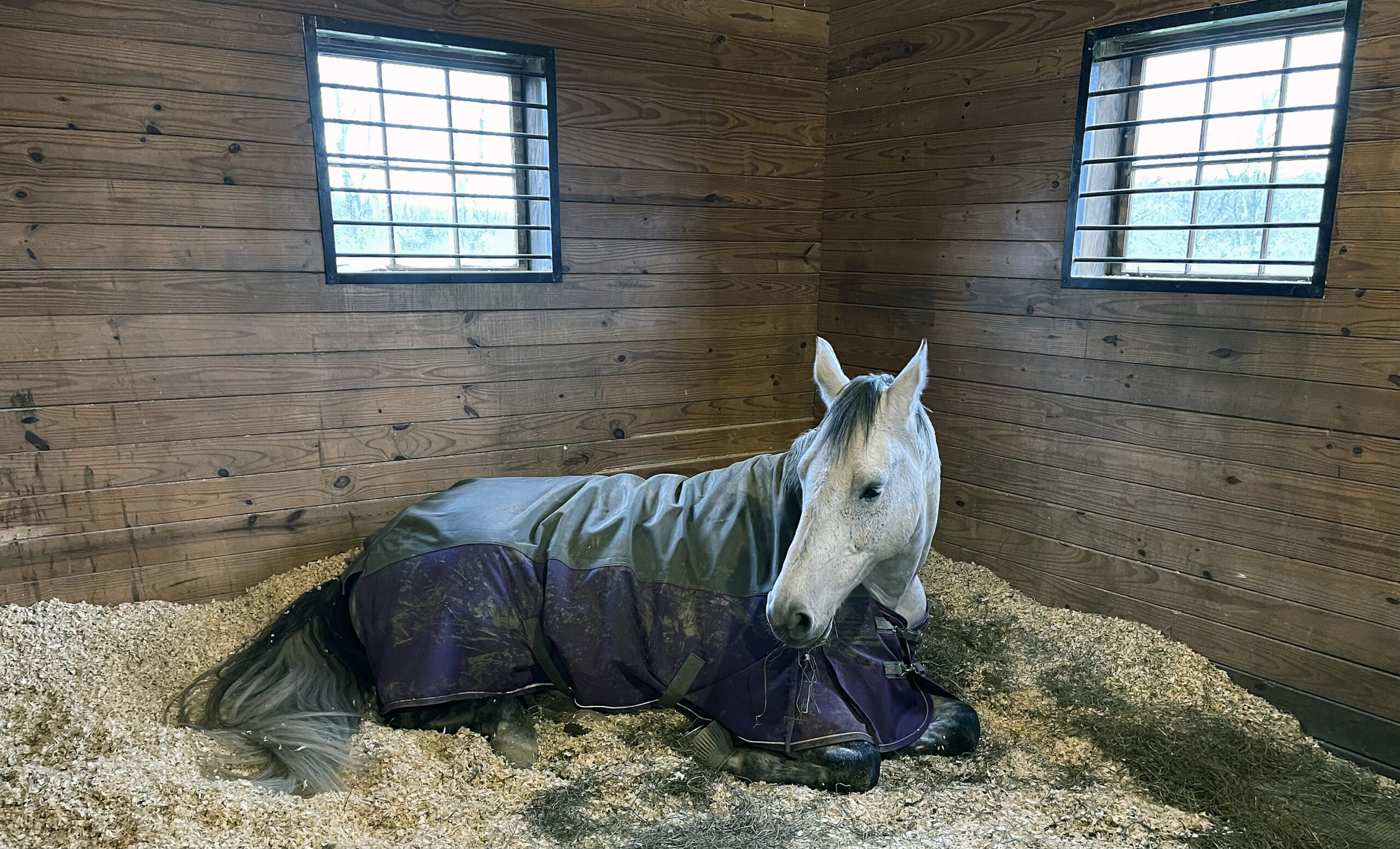
Research shows that horses spend more time lying down when their bedding is deeper, Greening says. She recommends at least 6 inches (15 centimeters) for all horses and potentially more for seniors—especially thin ones that have less padding around their bones.
A good way to test your senior’s bedding depth is with your own knees, Greening adds. “If you drop to your knees on your horse’s bed, and it hurts, imagine what that must feel like in the proportion of the animal that is having to do that constantly for recumbency,” she says, referring to a test originally designed to assess cattle bedding.
And while rubber can provide a useful base, it’s important to note that stall mats—even the high-end, multilayer kind designed for durability, comfort, and drainage—are never a substitute for bedding. (The exception is the use of medical-grade mats in veterinary hospitals.)
Deep bedding might feel like an expensive luxury, but it’s essential, she adds. And 6 inches isn’t as deep as it might seem. “Everyone always imagines that 15 centimeters is huge,” she says. “But actually, it’s not even the length of a slice of cantaloupe.”
2. Choose bedding that keeps your senior warm and breathing comfortably
Bedding doesn’t just cushion senior horses’ joints; it can also help regulate body temperature and provide enrichment, says Greening. Some bedding, however, can also trigger allergies and respiratory issues, and different bedding types can be harder to find depending on where you live. That means there’s no single bedding option for all seniors, she explains.
Straw generally provides better insulation than wood shavings, says Greening. That might be particularly important for seniors that struggle to maintain weight and use up energy keeping warm. “It’s really interesting to think about how they might use the bedding in a conduction kind of situation for their own thermoregulation,” she says.
Plus, horses tend to enjoy lying on straw and foraging through it, which can help keep older minds and bodies occupied.
Shavings and peat can offer good alternatives when straw isn’t easily available. They’re often considered less dusty, which can make a considerable difference for older horses with allergies or asthma. Owners can also shop around for high-quality straw that’s low dust, Greening adds.
Regardless of the bedding choice, however, owners should always ensure good ventilation to encourage cleaner air, she says.
3. Give your senior room to stretch out and feel safe
Senior horses need enough space to lie down, stretch out completely, and get back up comfortably, Greening says. She suggests measuring from nose to tail and adding approximately 5 feet (1.5 meters) for the horse’s bedded area. “If you watch older horses getting up and down, it’s definitely not just up and down,” she explains. “There are steps before and after, so they need that space to be comfortable in those maneuvers.”
That might take up the entire stall, she says. But if the horse has a large stall or shelter, owners can create a bedded area that only covers the space needed for lying down. This strategy not only reduces costs and waste but also allows the horse to choose where to stand, and how to use the available space. “More and more welfare researchers are talking about horses needing choice and providing functional areas for horses to work out how they would like to use that,” she says.
Even when the bedding is ideal, senior horses might not necessarily lie down in it if they feel unsafe, adds Katherine Houpt, VMD, PhD, Dipl. ACVB, professor emeritus at Cornell University’s College of Veterinary Medicine, in Ithaca, New York. Older horses tend to take longer getting up, making them more vulnerable to predators as well as higher-ranking horses. Seniors often feel more secure behind a stall door during resting periods, or at least with dividers that offer partial seclusion. Importantly, they should always have a second exit to avoid getting trapped.
4. Keep the bedding clean and dry
A clean bed is a more inviting bed, Greening says. So ideally, bedding should be cleaned regularly—at least once a day before bedtime. Remove droppings and wet bedding and adding fresh replacements, followed by a weekly deep-clean mucking.
Deep littering—leaving a compacted base of bedding in place and adding fresh material on top—has gained popularity as a way to save time and cost, she says. But it’s a lot of work and requires careful attention to weekly cleanliness to avoid excessive moisture or ammonia and bacteria buildup, as well as damage to the rubber matting underneath. For seniors, “I wouldn’t necessarily recommend it,” says Greening.
Owners can also use the knee-drop test to check for dampness, she adds. Simply kneel on the bedding for 30 seconds. “If your knees don’t get wet, then that’s a good sign,” she says.
5. Monitor your senior’s bed behavior and adjust accordingly
Every senior horse is different, so recommendations for bedding depth, materials, and space are starting points, not one-size-fits-all solutions, says Greening.
Stall cameras can give owners valuable feedback about when and if their seniors lie down and stretch out fully. It can also reveal critical information about how the horses are getting up and down as they age and whether they’re struggling, staggering, or even collapsing. If senior horses live in a shared space, cameras can also tell us about herd dynamics and if the older horses’ sleep is getting interrupted.
Observations like these can help owners play around with bedding type, depth, and space to tweak for their individual seniors, Greening says. The ultimate goal, she explains, is to create a resting environment that feels right for each horse.
Paying attention to your senior horse’s bedding needs can help him live comfortably and get the rest he needs throughout his later years, Greening says.
Related Reading
- Is Your Older Horse Getting Enough Sleep?
- My Senior Horse Podcast: Equine Sleep Deprivation
- How to Manage a Stall-Confined Senior Horse
Sign up for My Senior Horse’s FREE newsletter to get the latest information about equids 15 years and older delivered straight to your inbox!
-
View all posts
Christa Lesté-Lasserre is a science journalist specialising in animal health and behaviour, life sciences, and evolutionary processes. Her articles and stories have appeared in major science magazines and literary reviews in multiple languages across the globe. Based in France's greater Paris area, Christa holds an MA from the University of Mississippi and a BA from Baylor University in Texas, complemented by postgraduate work in life sciences at the University of Paris René Descartes.
A Pulitzer Center grantee for her coverage of the COVID-19 pandemic for Science magazine and recipient of American Horse Publications awards for her articles on equine behaviour, Christa focuses on shaping scientific studies into the stories they tell.