Safety is important for senior horses and the humans who care for them. Aged horses can suffer from ailments and illnesses that cause their physical or mental abilities to decline. Affected senior equids can become dangerous to themselves and their human handlers, or their lives can become insurmountably challenging.
On this episode, Dr. Nic de Brauwere, Head of Welfare and Behavior at Redwings Horse Sanctuary in the U.K., joined us to talk about safety considerations for senior horses. He has spent 30-plus years at Redwings dealing with rescued and abused equids, and his experiences can help us better understand how we can safely work with horses that have physical or mental deficits. This will help us know when it is better for the animal and handlers to grant a humane end. (Read more about Dr. de Brauwere below.)
There are more than 1,000 horses under the direct care of Redwings personnel. There are more than 600 in foster homes that are supervised by Redwings.
Common Issues
Some issues de Brauwere has seen with senior horses and ponies include tripping, falling, vision loss, animals unable to rise or stand, behavior or physical difficulties for vets/farriers, animals stuck in stalls, and more.
He said in his early time at Redwings, the age of the oldest horses and ponies was about 20-24 years. Now, he said, they can live much longer.
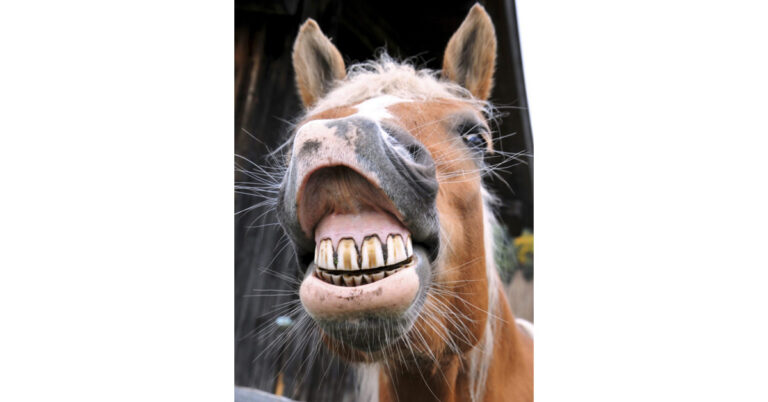
In the early days, de Brauwere said there were fairly fundamental issues such as bad dentition. “The mouth was causing the horse intense suffering,” he said. “They lost weight, and it was the right thing to do to euthanize them.”
Then the industry developed ways to treat and manage those conditions. “With better nutrition, dentistry, and prevention of parasites, horses were living longer.
“Perhaps we kind of peeled back conditions that had never really been that obvious because horses didn’t live that old,” said de Brauwere. “We have to recognize that dementia and deterioration of mental capacity is something we’ve only really tuned into recently.”
Horses are living longer, so osteoarthritis is something most older horses are affected with. “In my view, no horse escapes that since we are able to help horses live longer,” he added.
Quality of Life
“We have to question whether we are doing them a service” in helping them live so much longer, said de Brauwere. “We are fixing some things—often treating the basic fundamentals—and their hearts just keep going, the gut just keeps going, and they will carry on eating because it is such a basic instinct for survival Then we have to make quality of life decisions that are much harder because they fall to us to make.”
Some horses with severe arthritis lose the ability to bend their legs comfortably, causing them to trip and fall, he said. “A horse can be difficult for the farrier because it’s actually too painful to stand on the opposing limb,” said de Brauwere. “It’s not behavioral even though we may notice the behaviour first.”
This isn’t to say you should automatically put your horse to sleep because it trips, he stressed. “We’ve developed a number of ways, including medication, to help many of those horses enjoy a good quality of life for longer.”
When a new horse comes into Redwings, the personnel often don’t have a lot of background on the animal. “You have to try to figure out whether what we have in front of us is something we can manage or fix. Or is it something that’s at the point of no return. But, while you are doing that, you may need to give them temporary help at the beginning of their recovery,” he said.
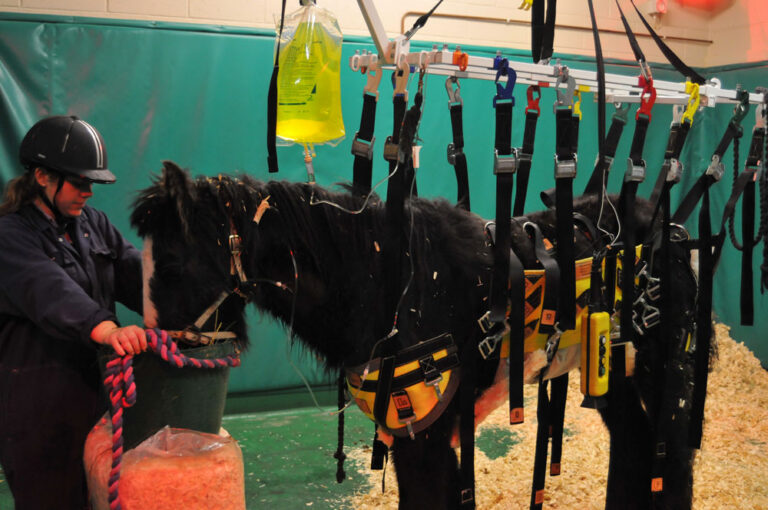
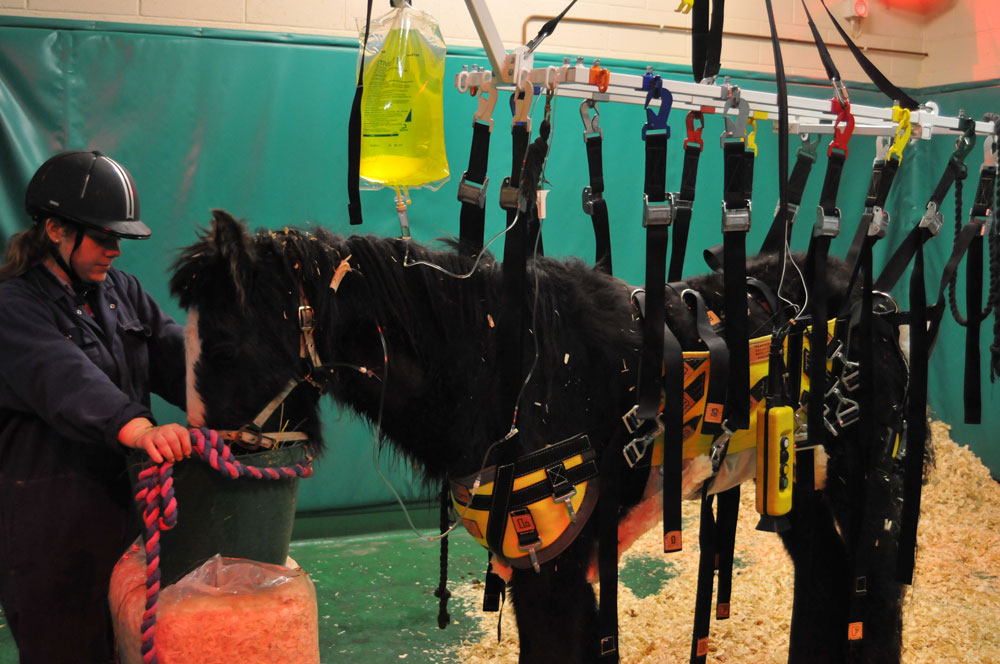
That help might include using an Anderson sling to support them in standing.
“These new horses that have just come to us often look to a great future and have 3, 5, 10 years with us after that,” he said.
Distress Decisions
Sometimes, a horse at Redwings experiences progressive arthritis that becomes increasingly difficult to manage. “Then they get a colic that probably could be fixed with surgery, but you’ve got to ask yourself if the horse can cope with invasive surgery and recovery, and what their life would look like once the colic is resolved,” said de Brauwere.
With other horses, you notice subtle signs of lameness or stumbling. “Then you come to the stable and they can’t get up,” he said.
“All of the points I’ve made, I think, reinforce what most of us in the horse world know. Horses rarely pass away peacefully in their sleep. We are witness to the unpleasant side of getting old. And when things start to fall apart, we have to make the right decisions for them.”
Training Handlers
The handlers managing seniors with physical and mental issues must be trained properly to ensure their own and the horse’s safety. But how do you select and train those people?
“In the olden days, I think it would require what would have been called good horsemanship, but as an employer, we have a responsibility to our colleagues to make sure they can work safely with our horses,” said de Brauwere.
Redwings employs several hundred people. They take that responsibility incredibly seriously. De Brauwere credits the government with forcing safety into the equine industry. “And, people want to go home after a day’s work,” he added.
Redwings follows a health and safety framework it has developed over many years. “We have structured training for our people,” he noted. “Experienced members of staff mentor their colleagues to help apply best practices. Having a sound grasp of how horses think is essential to working safely around them. Being able to understand how horses might react especially when we try help them in times of discomfort or distress.”
Facilities
Over the years, Redwings has developed an infrastructure (stables or all-weather corrals) that is appropriately sized for the horses. It also has specialist facilities for new arrivals that are the most likely to need extra support.
“We learned the hard way when we had a fairly heavy horse, an emaciated recent rescue, that went down in a stable where we couldn’t get our vehicle to,” he said. “We had to pick her up with people power, which could have been really quite dangerous to anyone who wasn’t one of the trained team working to save her. This also wasn’t sustainable, and we managed to move her to a barn where we could help her more easily if needed again.”
Redwings has tractors with mechanical arms suitable for lifting horses. It also has slings and personnel trained on how to use them. This specialized equipment is intended for the recent rescues still too weak to get up easily without help.
A more common risk that can affect even healthy horses is getting cast in a stable or shelter. “Our staff, as part of their early introduction to the organization, get training on how to work with a horse that’s gone down for a sleep or a roll in the stable and got cast,” explained de Brauwere.
Redwings usually has teams available, and colleagues work in pairs when handling horses. They also train each person how to use long ropes to turn a horse so it can get up.
“But, then you need to be able to get out of the way fast, especially if it’s one of the semi-feral ponies that my team looks after. You don’t want to be there once they can get up!” he said.
Tinsel
Horses change as they become healthier, such as horses that are extremely thin when they arrive. “At first you can pick them up because they weigh next to nothing,” said de Brauwere. “Then they start to get heavier, and it seems sometimes they still want you to pick them up! That becomes an issue.
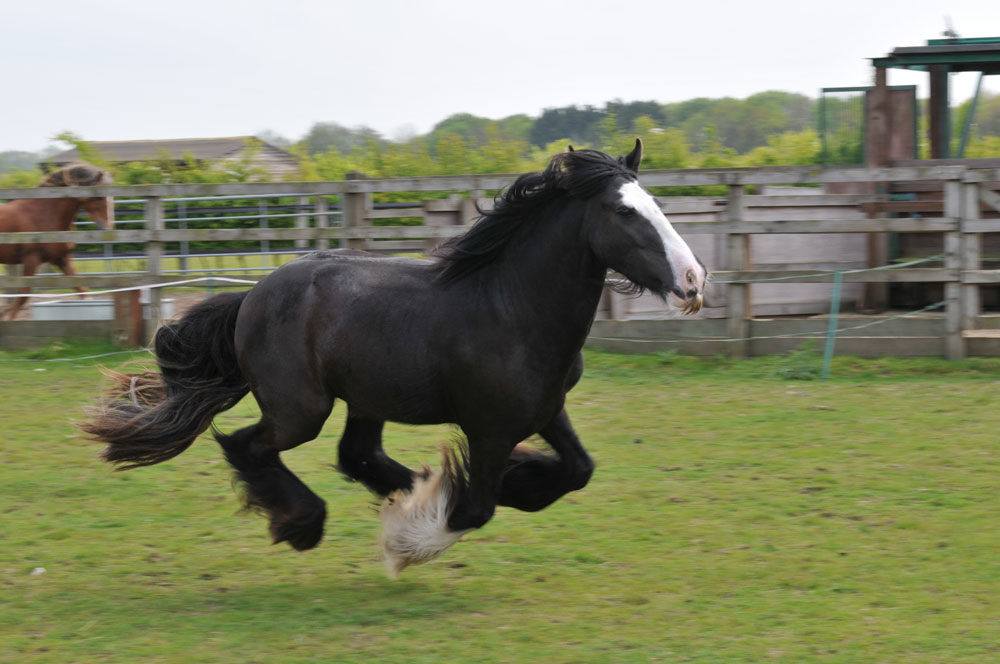
“We had a horse called Tinsel that came into Redwings emaciated,” he recalled. “He was so weak and lacking in muscle that he needed the support of our sling both to lift him after a sleep and to support whilst up, over a period of weeks as he regained strength and also muscle mass. As he got better, we did wonder if he was enjoying our efforts too much when he didn’t seem to make the effort to get up on his own. Though we chuckled at this possibility, it was more likely that he still was too weak to do things on his own. Having the equipment and trained staff ensured we could see him through to a full recovery.”
(You can hear more of Tinsel’s story and learn about some other rescues in the podcast.)
Emergency Training
In the U.S., the Technical Large Animal and Emergency Rescue (TLAR) helps train people on large animal rescue. There are similar organizations in other parts of the world.
“You need proper training around what happens when a horse goes down between two parts of a cross-country jump or a horse is stuck in a horse box,” said de Brauwere. “How can you know where the dangerous areas are? If the horse tries to get up, the legs are going to flail around. If you’re fiddling around in between the legs, you’re going to get hurt.”
Redwings has a rule that all staff who work with horses receive comprehensive safety training. They also wear steel-toe cap boots and a hard hat (helmet). “We have accepted that personal protective equipment is the last line of defense, and if you need your hat to save your life, other things have gone wrong, but they have still proved invaluable on many an occasion,” stressed de Brauwere.
There are many different reasons that a horse can go down. Sometimes, said de Brauwere, personnel lift a horse and realize within 10 minutes it has colic. “Popping them on their feet wasn’t going to solve the problem without also giving the necessary veterinary care,” he noted.
Feral Animals
De Brauwere said some of the feral horses and ponies they rescue are so emaciated they can’t run away. “But actually, they are living in absolute terror while you’re going up to them and putting on a sling and lifting them up,” he said. “That can have lasting behavioral issues where the horse doesn’t want to engage with you.”
The teams learned from experience to be more careful of forcing their way around a terrified horse that can’t escape.
“At our quarantine center, our team is very good at just giving horses like this what they need and no more,” explained de Brauwere. “After a couple of weeks, if the horse needs help, they tend to be much less affected by human presence than if we were to go in too hard and fast at the beginning of a rescue.”
Mental Issues
Researchers report that horses with pituitary pars intermedia dysfunction (PPID) can develop a form of equine dementia. “I think with human discussions around Alzheimer’s and dementia, sometimes it’s quite likely that the person is unable to comprehend where they are. That might cause them distress.
“With our animals, I think with dogs in particular, when you notice cognitive decline creeping in, it often unsettles them,” he said. “We can’t really explain to them what’s going on.”
With horses, he said, if the animal isn’t quite who they used to be, that’s probably an important indicator that something’s amiss. That could mean a cognitive decline, brain degeneration, or another condition, such as liver failure.
“In advanced liver failure, the toxins that aren’t cleared from the blood have quite profound effects on the nerves,” de Brauwere said. “Eventually these horses just circle and look like they’re drunk. But, if you’ve had too much to drink, you know that horrible way that you feel with a terrible hangover. Potentially, these horses are also feeling nauseous, and it could be a very unpleasant experience for them.
“Pay attention to the changes in who they are. It can be an important warning sign,” said de Brauwere.
Could It Be a Tumor?
“I have done quite a few postmortems on horses when the vet world first recognized Cushing’s disease (PPID) in horses,” said de Brauwere. “We were expecting in most of them to find a tumor at the pituitary gland. That’s not necessarily the case.”
However, he said they have found tumors that take up space. They can press on the optic nerve, and some people have described vision loss in horses with PPID.
“Also, if it’s pressing on the brain, it could be causing headaches or other abnormal functions so they are not feeling themselves,” he said.
Neurologic or Other Problems
Redwings has admitted horses that seem to experience fainting episodes. There were others that probably were neurologic as foals and still didn’t walk normally when they grew up.
“In one particular group, all rescued from the same situation, thankfully none of them have fallen over or shown any signs of pain or distress,” he said. “Whenever we have a horse with persistent ataxia or weakness, the staff have to consider if those horses are safe to be in a field with other horses or where unsuspecting humans could climb a fence and become injured if the horse fell. Horses with mild impairment seem to live a good quality of life and pose no greater risk than the rest of the herd, so careful assessment is vital as part of our assessment of new cases.”
The staff are trained on where to safely stand around these animals in case the horse falls over, and they always work with the horse as a team.
“If an older horse suddenly becomes wobbly, this would make us more concerned that something is starting to fail that we cannot fix,” he said.
Medications
De Brauwere said they always consider whether they can cure a horse’s issue. If not, can they at least manage it?
He said caretakers, in consultation with their veterinarians, should not be afraid of quite generous doses of medications like bute, which has good evidence of safe levels for longer-term use. “You can try lower doses more times a day or at slightly higher doses once or twice a day,” he said. “Our philosophy here has worked really well for us, which is, if it seems to be working and it’s within the limits related to the size of the horse, we’ll carry on. If it seems to work for two years, well, hurrah!
“But, equally, if we get to the point where we have to exceed the doses that are safe, or we see side effects, then the decision is made for you,” he said.
Final Words
There are several pain scales for horses. “I think the Holy Grail is a kind of quality-of-life assessment tool for horses that is backed by proper science,” he said.
“The exciting thing for me is you learn about horses all the time,” he said. “Every time you peel back another layer, they become more complex and interesting, which is why they give us such pleasure to be around, because they are very dynamic.”
He recommended that horse owners stay curious and always look for new information that can peel back another layer into their horses.
“When your horse is telling you something, pay attention and do the right thing by it,” he said. “It may be as simple as just getting your farrier and your vet to work together.
“At some point, you have to make the decision at the right time to say goodbye,” de Brauwere stated. “That’s quite a challenge, but equally it’s a privilege to be a custodian of a horse than can grow old well.”
About Dr. Nic de Brauwere
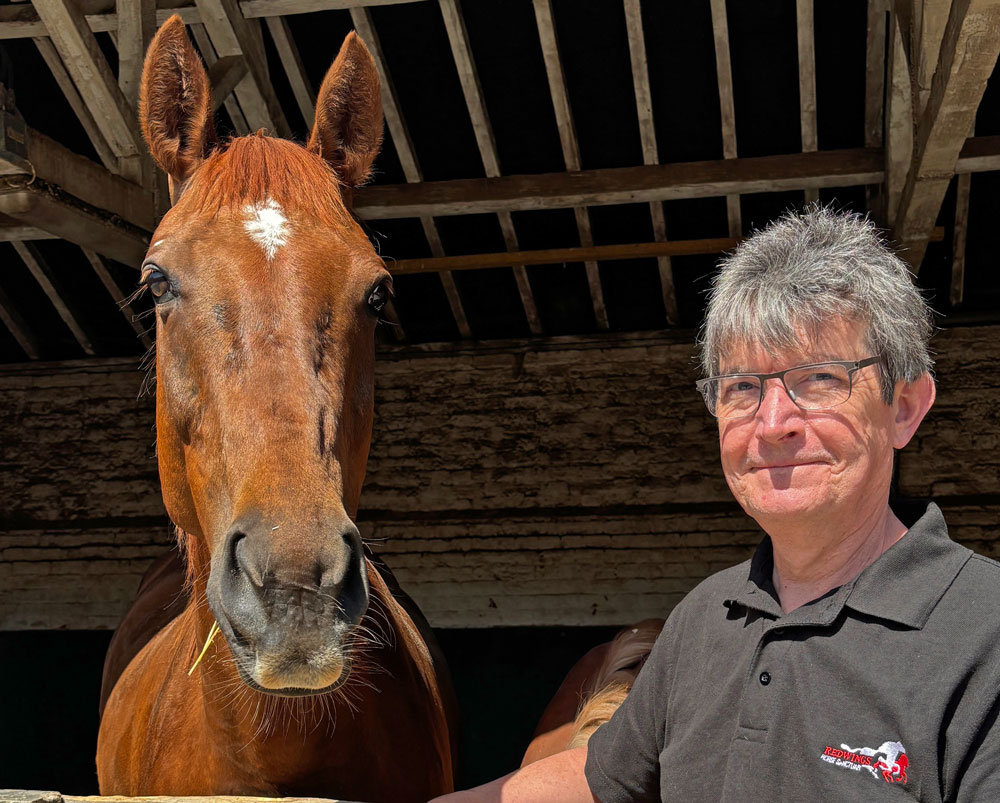
Dr. Nic de Brauwere is Head of Welfare and Behavior at Redwings Horse Sanctuary. He graduated as a veterinary surgeon in 1991 from Onderstepoort in South Africa and has worked at Redwings Horse Sanctuary for more than 30 years, providing clinical services, herd health management, and equine welfare case work to facilitate rescue and alleviate the need for it.
As Head of Welfare and Behavior at Redwings, de Brauwere leads a team that has specialized in the rescue, rehabilitation, and long-term care of feral, unhandled, or mistreated horses for more than a decade. This extensive experience has fundamentally informed the charity’s approach not only to equine health and welfare but equine behavior and training.
De Brauwere’s extensive experience working in the field of equine welfare led to his appointment as the Chairman of the National Equine Welfare Council in 2009, an umbrella organization for equine rescue centers and sanctuaries across the UK, a position he held until 2022. De Brauwere has been involved in consultations on many areas of animal welfare policy. Most notably in this context, he worked with the Welsh Government between 2012 and 2014 to assist them in drafting the Control of Horses (Wales) Act, which became law in Wales in 2014 and helped energize the commitment to an English equivalent that came into force the following year. In 2017, he was appointed Chairman of the Animal Welfare Network Wales.
Related Content
- Check out the Normal Aging articles on MySeniorHorse.com
- How Owners and Veterinarians Recognize and Manage Chronic Pain in Senior Horses. Dr. Rebecca Smith. MySeniorHorse.com
- Ridden Horse Performance Checklist: Behaviors in Ridden Horses that Might Signify Discomfort. Dr. Sue Dyson. MySeniorHorse.com
- Additional Behavior and Musculoskeletal Pain Signs in Ridden Horses. Dr. Sue Dyson. MySeniorHorse.com
- Anti-Inflammatories for Horse Barns. Dr. Nancy Loving. MySeniorHorse.com
- Tips on Using Bute Video. MySeniorHorse.com
- Survey Gives Equine Lameness Insights. Kimberly S. Brown. MySeniorHorse.com
- How a Comfortable Horse Should Appear During Ridden Exercise Part 1
- How a Comfortable Horse Should Feel During Ridden Exercise Part 2
- My Senior Horse Podcast: Horses and the Science of Harmony. Dr. Sue Dyson. MySeniorHorse.com
- Horses & the Science of Harmony. Dr. Sue Dyson and Padma Videos.
- The 24 Behaviors of the Ridden Horse in Pain: Shifting the Paradigm of How We See Lameness. Dr. Sue Dyson with Padma Video.
- Horse Behavior During Tacking and Mounting. Dr. Sue Dyson. MySeniorHorse.com
- Ridden Horse Performance Checklist: Behaviors in Ridden Horses that Might Signify Discomfort. Dr. Sue Dyson. MySeniorHorse.com
- How An Uncomfortable Horse Might Feel to a Rider. Dr. Sue Dyson. MySeniorHorse.com
Sign up for My Senior Horse’s FREE newsletter to get the latest information about equids 15 years and older delivered straight to your inbox!