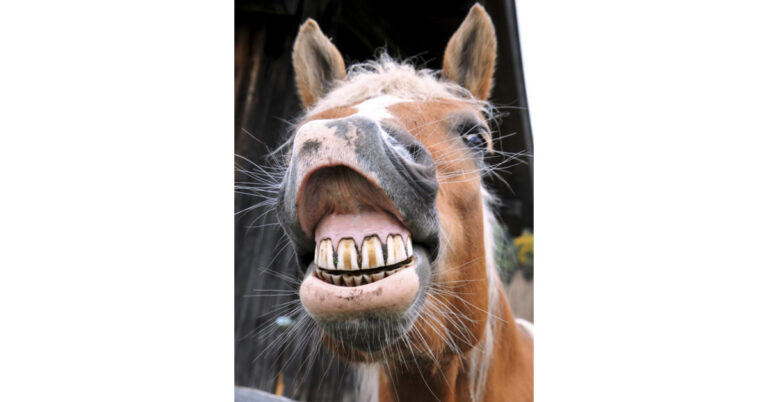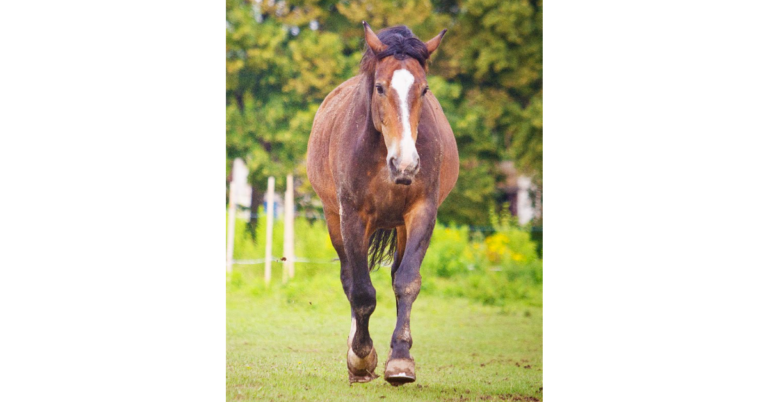
What is EOTRH in horses? We went to Dr. Jack Easley, a veterinarian and boarded equine dentistry specialist, for the answer. Easley strived for more than 20 years to create a specialty board for equine dentistry. Then, in 2013, Easley and 18 colleagues from around the world passed the first boards given to 24 veterinarians. He received Diplomate status in the spring of 2014. That is when the American Veterinary Dental College Equine Specialty was formally recognized by the American College of Veterinary Dentistry and the American Veterinary Medical Association (AVMA).
EOTRH stands for equine odontoclastic tooth resorption with hypercementosis. This condition causes the part of the tooth below the gum line to be resorbed by the body, Easley said.
“The same thing happens when a child sheds its baby teeth,” explained Easley. As the permanent tooth comes in, the body has resorbed the root off of the baby tooth. Easley said the same thing happens when young horses shed their baby teeth.
“As they shed their baby teeth, they shed what’s referred to as a cap because the roots have been resorbed off of the bottom of the tooth,” he said. The same type of resorptive process is seen in EOTRH.
Why Older Horses Are Affected
When a horse has EOTRH, the incisor teeth and canines at the front of the horse’s mouth go through cycles of tooth resorption and hypercementosis (excessive cementum buildup). Cementum is a layer of mineralized tissue that is softer than enamel.
Some horses just have resorption of the reserve crown under the gumline. Others lay down cementum or proliferative cementum in the root of the tooth. “They can have a combination of those,” said Easley.
Not all horses suffer from EOTRH, said Easley, and the condition is mainly found in older horses. The process has been seen radiographically in horses as young as 11, but usually it is seen starting in 17- or 18-year-old horses with no clinical signs, said Easley.
“As the horse gets older, because it’s a progressive condition, it starts to show up with clinical symptoms when they’re 20 or older,” he said.
What Are the Clinical Signs of EOTRH?
Horses become progressively more painful with this condition. Owners might not notice any clinical signs at first. Some signs that a horse has EOTRH include:
- The horse becomes uncomfortable or “doesn’t feel good.”
- There is excessive plaque or tartar build-up around incisor or canine teeth.
- The horse has mouth pain.
- Broken teeth are present (“Root resorption causes the tooth to be hollowed out in the middle, then it just breaks off,” noted Easley).
- There are pustules in the gums (blisters containing pus caused by secondary infections).
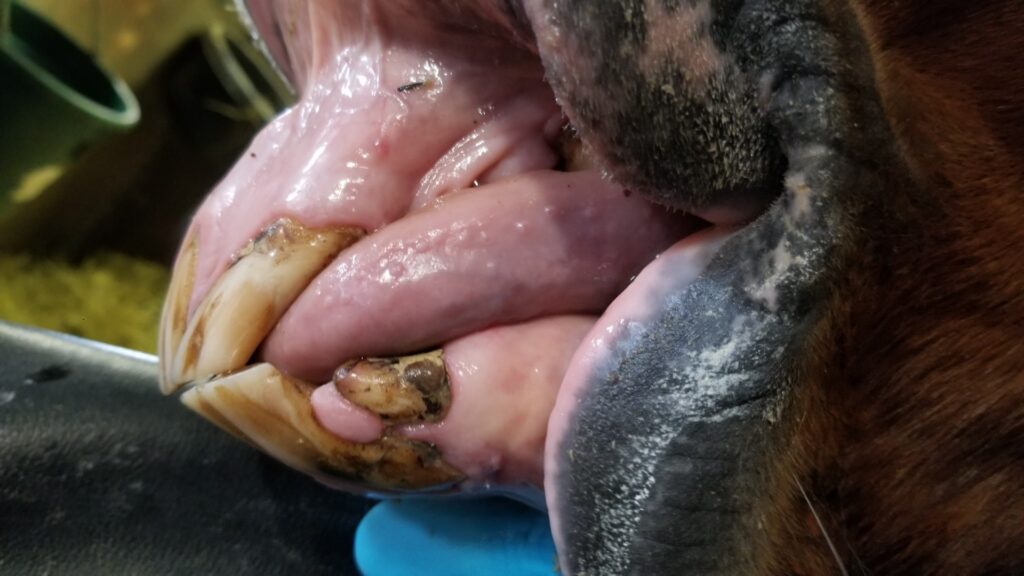
- The horse holds the tongue between the front teeth.
- The horse fails the “carrot test” (a horse is offered a carrot and doesn’t want to bite it with front teeth).
- The horse shows aversion to haltering or bridling.
“In early cases, the teeth actually look normal and the gums look normal, but if you X-ray them, you can see that there’s some resorptive lesions there in the roots or the buried part of the tooth in the bone,” said Easley.
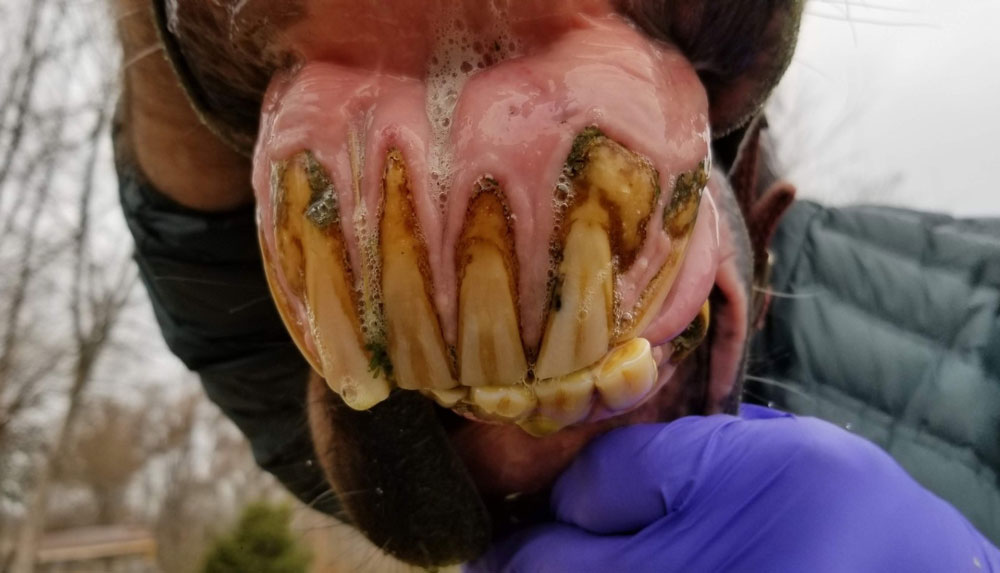
“Over time, they start to develop gingivitis and gum irritation,” he continued. “The affected part of the tooth that was below the gum starts showing in the mouth as the tooth continues to erupt. So, we have these black, rotten teeth that start to erupt up out of the gum, or the tooth breaks. It does become clinically apparent that something’s wrong with the teeth, and quite often it’s quite advanced by the time that happens because it’s been going on for a while.”

What Causes EOTRH?
“We don’t know what causes it,” admitted Easley. “The only thing that is consistent about it is that it is seen in older horses, and it does tend to be progressive.”
Research has shown that about 25-30% of horses over 25 years old have EOTRH. Easley said there is no way to predict which horses will get this disease.
“People have done studies looking at the biomechanics of the front teeth as horses age,” he said. “If you look at aging charts, the angles of the teeth change. They go from straight up and down to being more angled. So, as the angle of the teeth changes, the forces that are placed on the teeth change also. There’s some debate, but some work’s been done to show that it does change the forces that are placed on the teeth and that may have some bearing on inflammation in those teeth.”
He said one research study showed that stabled Icelandic horses had a five-times greater risk of EOTRH than native horses that live outside all the time.
This disease was first described as EOTRH in 2008, although veterinarians had seen the typical clinical signs “forever,” said Easley. “We just thought old horses got bad teeth when they got old.
“Now we know it is a disease syndrome that we can diagnose and treat,” he said.
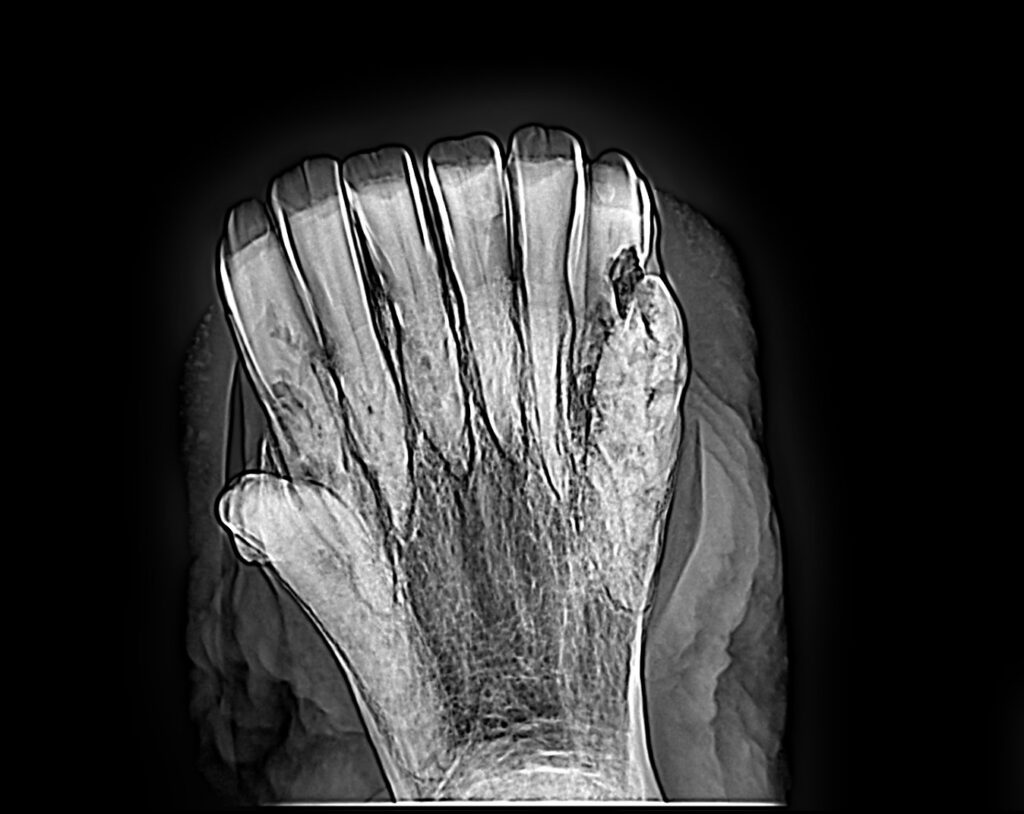
How Is EOTRH Diagnosed?
EOTRH is diagnosed by X-ray. This can’t be diagnosed without an X-ray, said Easley. “You can look at the horse and tell he’s got bad incisors, but you don’t know whether that’s from trauma, or malocclusion, or pockets between its teeth. You don’t know what’s causing it until you get an X-ray, and then you can see these resorptive lesions on an X-ray. They look like rats have been chewing on them; sort of moth-eaten.”
He added that the disease doesn’t affect all teeth the same way.
Easley said EOTRH has been diagnosed in some premolar teeth, “but it is extremely uncommon, and we don’t think it’s the same syndrome that we’re seeing in front teeth. Occasionally we do see some root resorption on cheek teeth, but 99% of the cases are just in these front teeth.”
How Is EOTRH Treated?
This disease is treated by surgically removing the affected teeth. Easley said the gums heal nicely, and the horse still can graze to some degree and it can move food into its mouth with just its gums.
“They seem to be comfortable and do well without any incisor teeth,” he said.
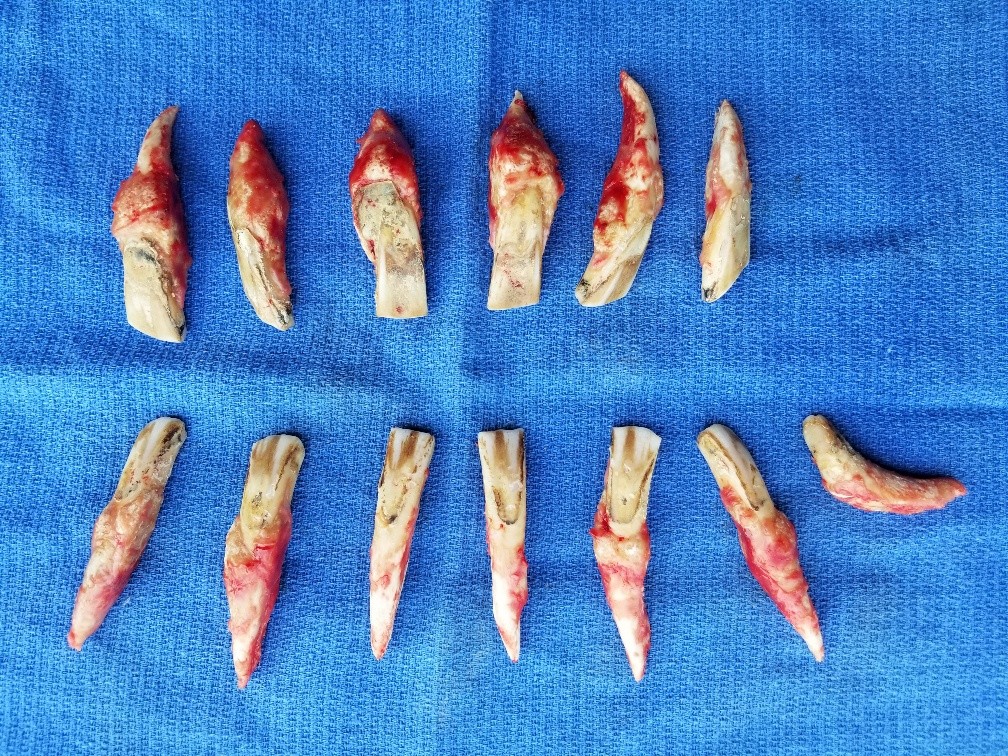
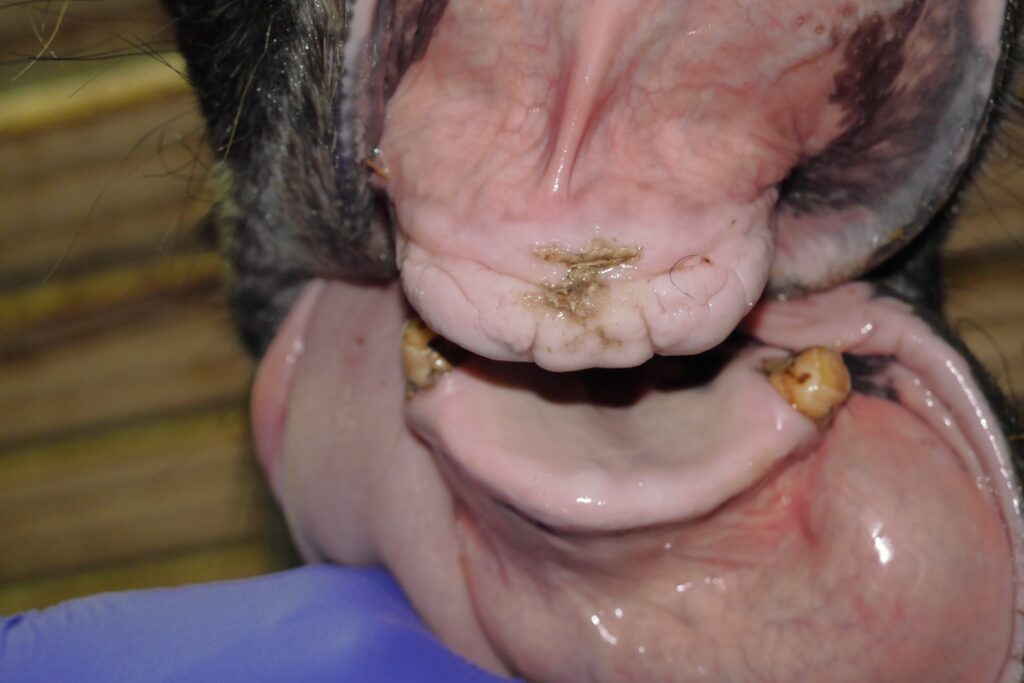
Below is the horse that had the teeth in the above image removed. “They go from this red, irritated, inflamed gum to just normal, healthy gum,” said Easley.
“They heal up really well,” he continued. “Sometimes they do hang their tongues out of their mouths after surgery because they don’t have any incisor teeth to hold the tongue in. So, when they relax or go to sleep, their tongue drops out. But they can pull it back in and hold it in their mouth.”
Final Words
Easley said it is important to have a good physical exam conducted on older horses.
“Just because a horse has EOTRH and they’re not feeling good, it doesn’t mean that they’re not feeling good because they have EOTRH.”
Further Content
- Check out additional articles that discuss senior teeth in the content category Teeth. MySeniorHorse.com
- My Senior Horse Podcast: Dental Care. Kimberly S. Brown with Dr. Jack Easley. MySeniorHorse.com
- Feeding Senior Horses According to Their Dental Health. MySeniorHorse.com
- Feeding Horses that Can’t Eat Long Fiber. Alex Beckstett. MySeniorHorse.com article and video
- Horse Teeth by Age. MySeniorHorse.com illustrations
Sign up for My Senior Horse’s FREE newsletter to get the latest information about equids 15 years and older delivered straight to your inbox!