In the equine industry, few conditions are as concerning and frustrating as insulin dysregulation (ID). Insulin dysregulation is a complex endocrine disorder that affects a large percentage of the equine population. It is the defining characteristic of equine metabolic syndrome (EMS). Most critically, insulin dysregulation increases the risk of laminitis, a painful and potentially career- or life-ending condition.
Current management strategies focus on restricting pasture access and feeding low-nonstructural-carbohydrate (NSC) rations. While widely recommended, these approaches have historically relied on limited scientific validation. This is particularly true regarding how ID horses respond to pasture and long-stem forages of varying NSC concentrations and restrictive grazing strategies.
Morgan Askins’ doctoral research at the University of Kentucky seeks to fill these knowledge gaps. She is generating data-driven recommendations that help veterinarians and horse owners proactively manage this devastating condition.
Understanding the Impact of Pasture and Seasonality
Seasonal fluctuations in pasture NSC concentrations pose a continual challenge for managing horses with insulin dysregulation.
Researchers monitored insulin in ID and non-insulin-dysregulated (NID) horses for two 24-hour grazing periods. These tests occurred in spring and late summer.
Elevated pasture NSC levels were associated with significantly increased insulin concentrations in ID horses. Importantly, when ID horses were removed from pasture and housed on a drylot with low-NSC hay, insulin concentrations decreased rapidly and remained reduced within 24 hours.
These findings highlight the metabolic sensitivity of insulin dysregulated horses to pasture carbohydrates and the effectiveness of rapid dietary intervention.
Long-Stem Forages and the Insulin Response
Researchers used a five-week randomized crossover study to evaluate the insulin response to six long-stem forages with varying NSC concentrations. Horses were either insulin dysregulated or non-insulin dysregulated. Two of the forages contained < 10% DM NSC, but they still produced an augmented insulin response compared to a negative control (low-NSC pellet).
Results suggest that feeding more than 0.13-0.135 g NSC/kg body weight per meal may result in an exaggerated insulin response in insulin dysregulated horses. These findings emphasize that total NSC intake per meal—not only percentage NSC on a forage analysis—must be considered when developing feeding strategies for ID horses.
Restrictive Grazing Strategies: Evidence for Practical Tools
To better understand real-world management practices, a nationwide survey assessed the use of restrictive grazing methods in the United States. Ninety-one percent of respondents used at least one restrictive grazing strategy to prevent or manage laminitis or excessive weight gain. The most common strategies were grazing muzzles or dry lots. Grazing muzzles were most frequently used for nine to 12 hours per day during spring and summer.
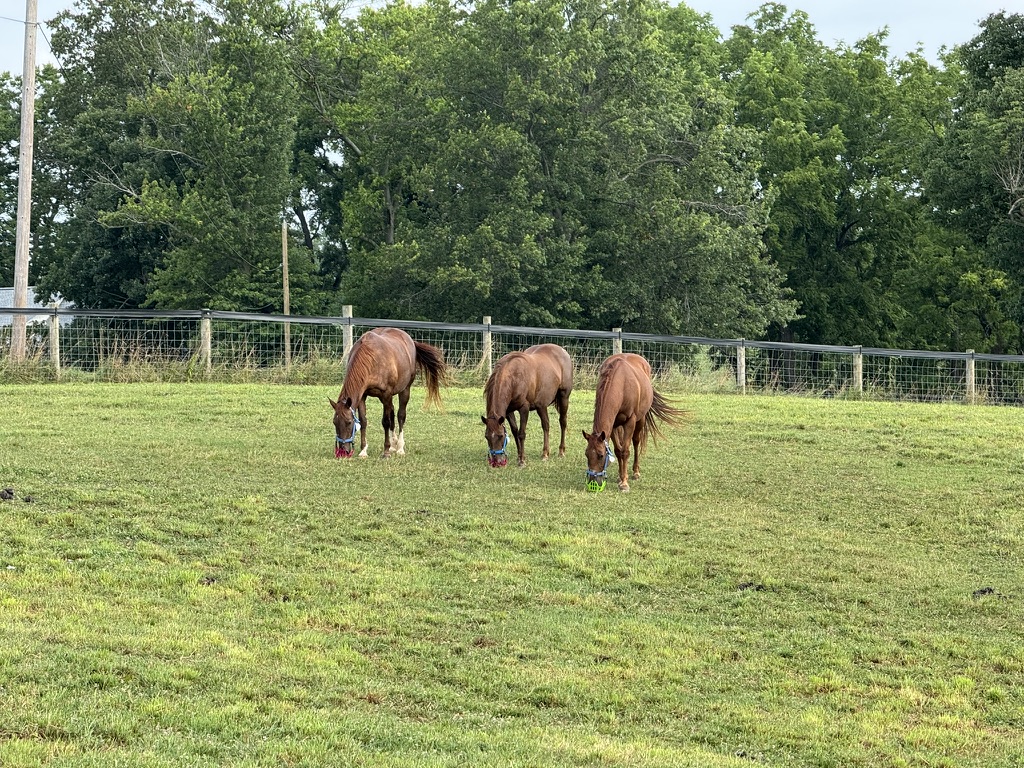
To evaluate the effectiveness of grazing muzzles, researchers monitored nine insulin dysregulated horses during four 10-hour summer grazing periods using a replicated 2×2 crossover design.
Horses grazing with a muzzle demonstrated significantly lower insulin concentrations compared to unmuzzled controls. All horses were on low-moderate pasture NSC (6.0-13.8% DM) conditions.
This data provides scientific validation for a commonly used management tool.
Advancing Proactive Management of Insulin Dysregulation
Collectively, this body of work highlights the critical influence of seasonality, pasture NSC content, forage intake, and grazing management strategies on insulin dynamics in insulin dysregulated horses.
The findings support the use of dry lots with low-NSC hay and grazing muzzles as potentially effective tools to reduce the insulinemic response in insulin-dysregulated horses. However, ongoing monitoring remains essential.
NSC concentrations can fluctuate rapidly with environmental conditions, and individual metabolic responses vary.
Study leaders wanted to refine feeding recommendations through controlled research. These studies can help improve equine metabolic health, reduce laminitis risk, and provide veterinarians and horse owners with practical, scientifically validated tools for managing insulin-dysregulated horses.
About the Researcher
Morgan J. Askins earned her Master of Science in agriculture with an emphasis in equine nutrition from Tarleton State University in 2019. She had completed her Bachelor of Science in agriculture with a concentration in animal science and a minor in entrepreneurship at Western Kentucky University in 2018. Askins’ doctoral research focuses on insulin dysregulation and nutritional management strategies to mitigate hyperinsulinemia-associated laminitis in horses. Her work has been presented at national and international scientific meetings. Those included the American College of Veterinary Internal Medicine Forum (ACVIM), the Global Equine Endocrine Symposium (GEES), and the Equine Science Society Symposium (ESS). At the latter, she received recognition for her graduate oral presentation. Askins aims to advance understanding of equine metabolic health through her research. She wants to contribute to improved, evidence-based nutritional management strategies for horses affected by insulin dysregulation.
For more information, contact Amanda Adams, PhD, Associate Professor Gluck Equine Research Center, Martin-Gatton College of Agriculture, Food and Environment, University of Kentucky, amanda.adams@uky.edu; or Morgan J. Askins, Gluck Equine Research Center, Martin-Gatton College of Agriculture, Food and Environment, University of Kentucky, morgan.askins@uky.edu.
Edited reprint from the Equine Disease Quarterly from the University of Kentucky, Maxwell H. Gluck Equine Research Center. April 2026. Funded by EQUUS / Standardbred Station, Inc., M&J Insurance.
Related Content
- Find more articles about metabolic disease in this category on MySeniorHorse.comWhat Senior Horse Owners Need to Know About Equine Metabolic Syndrome (EMS) video. Kimberly S. Brown with Dr. Cosette Faivre. MySeniorHorse.com
- Factors That Can Affect a Horse’s ACTH Test Results. Alexandra Beckstett. MySeniorHorse.com
- Canagliflozin Shows Promise as a Long-Term Treatment for Insulin Dysregulation in Horses. Kimberly S. Brown. MySeniorHorse.com
- Possible New Equine Insulin Dysregulation Treatments. Kimberly S. Brown. MySeniorHorse.com
- Horse Breeds, PPID, and Insulin Dysregulation. Kimberly S. Brown. MySeniorHorse.com
Sign up for My Senior Horse’s FREE newsletter to get the latest information about equids 15 years and older delivered straight to your inbox!
-
View all posts
Equine Disease Quarterly is published digitally in January, April, July, and October by the Maxwell H. Gluck Equine Research Center. It is sponsored by Equus Standardbred Station and M&J Insurance.