The measurement of basal (resting) adrenocorticotropic hormone (ACTH, which is secreted by the brain’s pituitary gland) is currently the most widely used test for diagnosing and monitoring horses with pituitary pars intermedia dysfunction (PPID). In these horses, ACTH concentrations are typically higher than normal.
“However, interpreting ACTH results is fairly challenging due to biological variability and multiple factors that can influence ACTH,” said Jo Ireland, BVMS, PhD, CertAVP(EM), FHEA, FRCVS, of the University of Liverpool. “So, comprehensive understanding of factors that might contribute to variation within individual animals and between different animals is required to help us optimize interpretation of ACTH concentrations when we’re diagnosing or monitoring PPID.”
She reviewed the research behind factors that could potentially affect a horse’s basal ACTH concentration during a presentation at the Equine Cushing’s and Insulin Resistance Group’s 2025 NO! Laminitis conference.
Month or Season
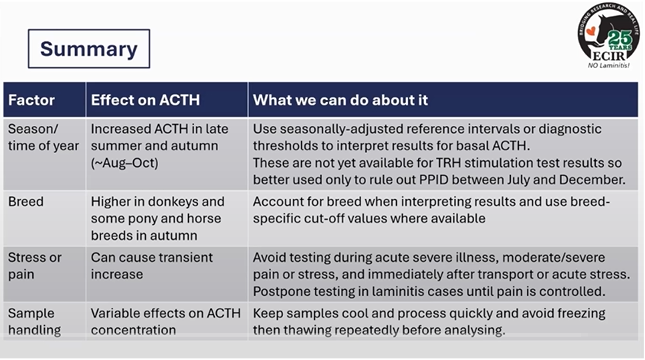
“Seasonal variation is the single most influential and most studied physiological factor that affects ACTH concentrations,” said Ireland, noting that study results consistently demonstrate that all equids have higher ACTH concentrations in late summer/autumn, with a significantly greater increase in those with PPID. In contrast, ACTH concentrations are lowest in Northern hemisphere horses in April/May (October/November for the Southern hemisphere) compared to other months.
“This seasonal rise is thought to be mediated by changes in day length, and it’s part of normal metabolic changes to help horses prepare for the winter months,” Ireland explained. “We now have seasonally adjusted reference intervals and diagnostic thresholds, and using those offers the best means to account for this circannual (within year) variation in ACTH concentrations to maximize diagnostic accuracy year-round.”
Some studies have shown ACTH tests to have the greatest diagnostic accuracy in autumn.
Geographic Location
Researchers have observed significant differences between horses kept in different latitudes and geographic regions. These findings are difficult to compare, however, because studies have used different locations between different countries.
“We currently don’t have a lot of information to inform how we adjust our interpretation of ACTH test results,” said Ireland, “and while location-specific cutoff values would be ideal, realistically that would be very challenging to undertake. However, as testing is typically conducted using laboratories, this may help reduce the impact of regional variation.”
Time of Sampling
Because of the way the hypothalamus controls the pituitary gland, ACTH gets released in short bursts or pulses at regular or irregular intervals throughout the day rather than at a steady rate. Concentrations have also been reported to rise and fall throughout the day, but study findings regarding this daily (circadian) rhythm in horses are conflicting.
“Several studies have found variations in ACTH concentrations at different times of day, but they’re not consistent,” said Ireland, citing one study showing ~40% decrease at 5 p.m. compared to 8 a.m. in healthy horses (Rendle et al. 2014). “Daily fluctuations appear to be lost in horses with PPID, which perhaps reflects changes in their hormone processing and release.”
Horse-Level Factors
She then reviewed studies evaluating horse factors (i.e., age, sex, coat color, etc.) and presented findings on those that identified significant relationships with ACTH concentrations.
Breed/phenotype/species
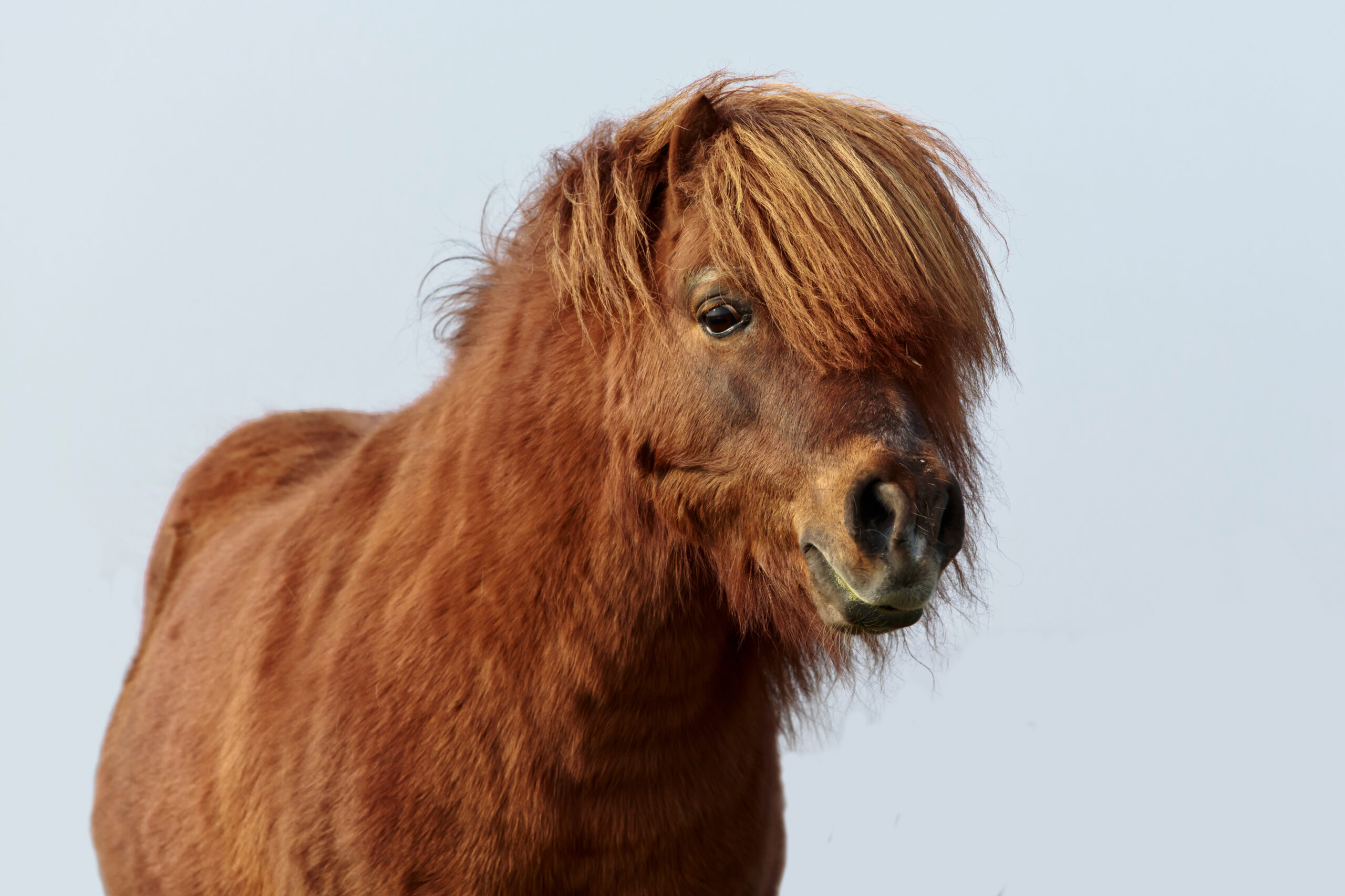
Most studies found significant breed differences, but they’re not consistent year-round and, as expected, are more common in autumn months. For example, researchers (Beech et al. 2009; Bamford et al. 2020, 2023) documented higher ACTH concentrations in donkeys and pony breeds:
- 27-106% higher in pones compared to horses.
- 267% increase in Shetland Ponies compared to Thoroughbreds in autumn.
- 83% increase in Andalusians compared to Standardbreds in autumn.
Based on these findings, veterinarians should consider breed when making PPID diagnoses. “There are lots of challenges with properly establishing reference intervals and diagnostic thresholds for ACTH, so it’s unlikely that a comprehensive range of different breed-specific values becomes widely available,” said Ireland. “Depending on the clinical presentation, it might be appropriate to use a higher threshold when interpreting results for ponies, donkeys, and thrifty horse breeds in autumn to reduce the risk of false positives.”
Age
While it’s common knowledge that PPID is occurs most frequently in older horses, researchers are divided on whether age itself affects ACTH concentrations. However, in all studies where a significant effect of age was reported, ACTH concentrations increased with increasing horse age:
- 14% increase in upper reference limit for ponies aged 13-32 compared to ponies aged 3-12 (Koller et al. 2016).
- 171% increase in geriatric horses (average age 20.6 years) compared to adult horses (average age 8.8 years) (Jacob et al. 2018).
- Greater magnitude of increase in ACTH during autumn (Pinn Woodcock et al. 2018).
“It’s thought that older horses might have some increase in baseline ACTH even in the absence of PPID because of some age-related dopaminergic nerve loss rather than true PPID changes,” said Ireland.
Reproductive and Health Status
Researchers have studied these types of horse factors in low numbers. Interestingly, said Ireland, three studies looking at the effects of body condition score or obesity found no significant differences in ACTH concentrations. Scientists have noted significant differences in ACTH in mares at different points in their estrous cycle, during pregnancy, and in the early post-foaling period. However, she said, it’s difficult to compare those results and make clear testing recommendations because the studies used very different time points.
Illness and Pain
Activation of the hypothalamic-pituitary-adrenal (HPA) axis results in an increase in ACTH in normal horses because it’s a stress response hormone. This is important to understand because stress, concurrent disease, and pain can influence ACTH levels and potentially affect diagnostic test accuracy. And PPID cases are already at higher risk of having chronic and/or acute health conditions, said Ireland.
Evidence in the literature varies with respect to the conditions investigated:
- Two studies looking at medical and surgical colic cases found no significant association between ACTH and composite pain scores.
- Studies from referral hospitals found significant increases in ACTH concentrations in cases of acute gastrointestinal disease (e.g., colic), systemic inflammatory response syndrome, equine grass sickness, other acute and chronic conditions (trauma, arthritis, myositis).
- ACTH levels were increased (up to 178%) in horses with acute, chronic, or historical laminitis.
Handling and Veterinary Procedures
Small numbers of studies have looked at handling and veterinary procedures. One that might be of importance when performing diagnostic tests for PPID, however, involves the use of a nose twitch. In one study, a nose twitch applied for 2 minutes resulted in ~178% increase in ACTH concentrations, and ACTH remained higher up to 13 minutes following twitch removal, said Ireland.
Research findings on the effects of sedatives are variable, she said, but the Equine Endocrinology Group recommends sampling for baseline ACTH immediately (within 5 minutes) after sedation to avoid affecting test interpretation.
“This can definitely pose some challenges for horses that are very averse to injections (ACTH tests require blood samples),” she said. “It might be that behavioral approaches such as differential reinforcement over time might be required to have a calm enough patient to be confident that stress or the physical or chemical restraint techniques we’re using aren’t having a major impact on our test results.”
Regardless of how they’re administered (topical, systemic, inhaled), corticosteroids consistently result in significant decreases in ACTH. So, Ireland advises against sampling for PPID diagnosis or monitoring during or a short time after corticosteroid treatment to reduce the chances of false negative results or overestimating how well a horse is responding to PPID treatment.
Management-Related Factors
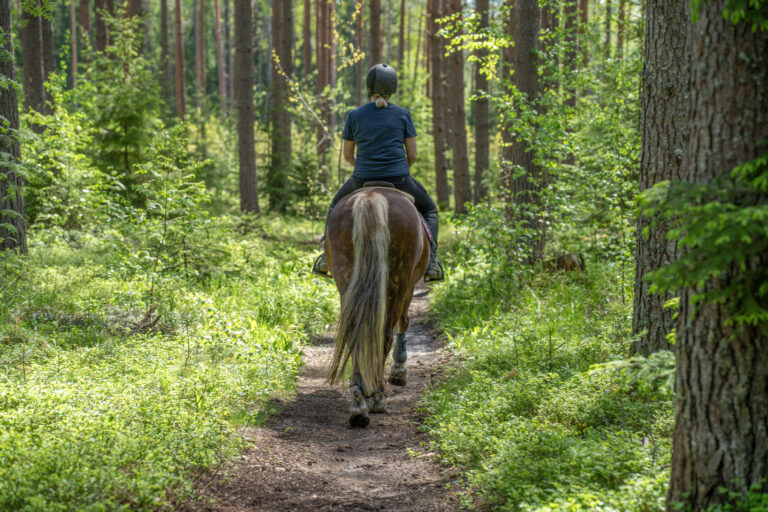
The most-studied management factor with regard to ACTH is exercise of varying types and intensity.
“High-intensity and treadmill training—things that were found to result in large increases in ACTH—are likely not relevant to the diagnosis of PPID in practice,” said Ireland. “However, increases were reported after as little as 30 minutes of low-intensity ridden exercise. Therefore, avoiding sampling in the immediate post-exercise period (30-60 minutes) would be advisable to reduce risk of false positives.”
Long-distance transport has also been shown to increase ACTH concentrations. In one study, researchers documented 172% increase after a 50-kilometer journey in donkeys. Another found significant increases after a 40-minute journey, which is comparable to the distance owners commonly trailer horses to veterinary clinics.
“We’d advise when possible that PPID testing should be undertaken in the animal’s usual environment,” said Ireland. “In horses that have been transported for testing, it’s important to consider that some horses might have elevated ACTH levels.”
Findings regarding testing in fed vs. fasted horses or on the type of diet fed have been variable, but she cited significant increases in ACTH concentrations in horses on alfalfa hay and high-starch diets.
Sample Handling and Analytical Factors
Different assay platforms yield different ACTH results. “This is not necessarily a problem, you just want to be sure you’re interpreting your results based on the assay that was used,” said Ireland. “Differences between assays also seem to be different between horses and ponies.”
As far as sampling handling, we know that ACTH can break down quickly if a blood sample gets too warm or is not handled properly. “The impact of this appears to be much less significant than we originally thought,” she said. “However, good sample handling with temperature control (e.g., keeping them chilled) with quick processing is still considered important to get the most accurate results.”
Take-Home Message
In summary, Ireland said the available research into factors affecting horses’ PPID levels is extremely varied. Of importance, most of the studies her team reviewed did not include PPID cases. Results from studies that only include healthy equids may not always be directly extrapolated to PPID cases, she cautioned.
“There are numerous factors associated with significant changes in ACTH, but the findings are not always consistent between studies, some statistically significant differences might not be clinically significant for PPID diagnosis, and the relationship with diagnostic accuracy for PPID remains undefined,” she said.
Things she said we can be confident about include:
- Breed, illness, exercise, and transportation can increase frequency of false positives.
- Corticosteroid administration and suboptimal sample handling conditions can increase frequency of false negatives.
References
- Ireland JL, Lester A, Banse HE. Factors affecting measurement of basal adrenocorticotropic hormone in adult domestic equids: A scoping review. Vet J. 2024 Apr;304:106071. doi: 10.1016/j.tvjl.2024.106071.
- Menzies-Gow NJ, Banse HE, Duff A, Hart N, Ireland JL, Knowles EJ, McFarlane D, Rendle D. BEVA primary care clinical guidelines: Diagnosis and management of equine pituitary pars intermedia dysfunction. Equine Vet J. 2024 Mar;56(2):220-242. doi: 10.1111/evj.14009.
Related Reading
- Research on Long-Term Treatment of PPID Horses
- Developing a Feeding Plan for Your PPID Horse or Pony
- Are Warmblood Breeds Prone to PPID and Insulin Dysregulation?
Sign up for My Senior Horse’s FREE newsletter to get the latest information about equids 15 years and older delivered straight to your inbox!