Researchers in the U.K. wanted to develop a novel instrument to measure the “multi-faceted dimensions of human-horse attachment.” They published a scientific paper in December 2025 titled “Development of the Human–Equine Attachment Scale.”1 They named the scale the Human–Equine Attachment Scale (HEAS).
The researchers noted, “Human–horse relationships encompass diverse roles, from companion to competition partner.” The impact of such bonds informs owner decision-making regarding horse management and veterinary care, they noted.
Background
A systematic review of human and animal attachment research helped in development of initial scale factors. The U.K. scientists made adaptations (see below) to reflect human–equine relationships.
“The preliminary scale contained 25 items across five hypothesized factors: Companionship, Wellbeing, Dependence, Status, and Growth,” the study stated. However, Sacrifice was added to the final scale.
Data was collected through an online survey in the spring of 2022. A total of 3,611 predominantly female (92.9%) respondents completed the survey.
The final principal components analysis “revealed a six-factor solution explaining 60% of total variance: Companionship (19%), Personal Wellbeing (9.8%), Dependence (8.9%), Status (8.5%), Growth (7.5%), and Sacrifice (6.3%).
Conclusions
Sacrifice was not included in the initial factors, but emerged through the survey. Researchers noted this “highlights unique aspects of horse ownership, particularly regarding financial and personal investment.”
The summary of the research noted that the Human–Equine Attachment Scale (HEAS) “shows promise as a reliable tool for measuring human–horse attachment.” They said there were numerous potential applications.
“It could help bridge the gap in knowledge regarding owner motivation and human–horse relationships,” noted the researchers. They added that their study supports research into how attachment influences welfare, management, and veterinary care decisions.
The Human–Equine Attachment Scale can help us understanding the complex nature of human–horse bonds, noted the researchers. The results also point toward “implications for owner decision-making and practice.”
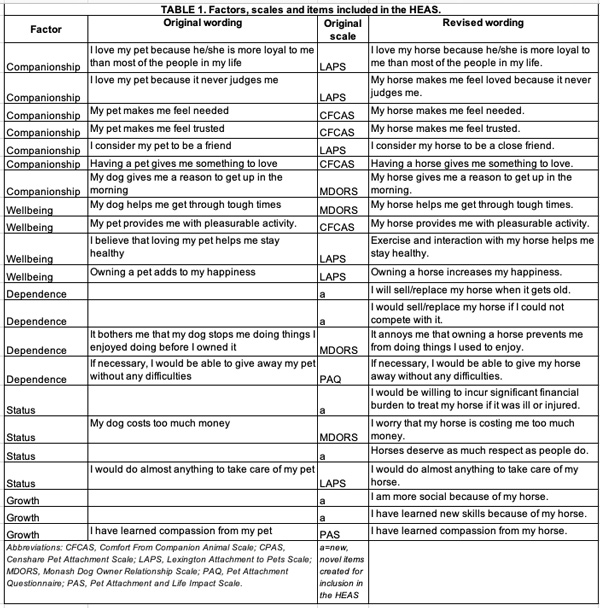
Factors and Scales in HEAS
The four-point Likert Scale (1 = Strongly Agree, 2 = Agree, 3 = Disagree, 4 = Strongly Disagree) was used in the survey. They removed the neutral midpoint to encourage participants “to provide clear directional responses, which enhances the discriminatory power of the data.”
(Editor’s note: Check out the revised wording taken from other pet-human attachment scales, and some statements added just for this equine research.)
Reference
- Development of the Equine-Human Attachment Scale. Equine Veterinary Journal. December 2025. Richard H. Corrigan, Marc Pierard, Emma Davies, David Marlin, Stephanie Evans, Jane M. Williams.
Further Content
- My Senior Horse Podcast: Equine Behavior. Kimberly S. Brown with Dr. Kris Hiney. MySeniorHorse.com
- My Senior Horse Podcast: Positive Reinforcement. Dr. Eleanor Girgis. MySeniorHorse.com
- Study Suggests Horses Smarter than Previously Thought. MySeniorHorse.com
- ‘Feel-Good’ Horse Touch, Such as Scratching. Dr. Sue Dyson. MySeniorHorse.com
- My Senior Horse Podcast: Horses and the Science of Harmony. Dr. Sue Dyson. MySeniorHorse.com
- Horses & the Science of Harmony. Dr. Sue Dyson and Padma Videos.
- The 24 Behaviors of the Ridden Horse in Pain: Shifting the Paradigm of How We See Lameness. Dr. Sue Dyson with Padma Video.
- Horse Behavior During Tacking and Mounting. Dr. Sue Dyson. MySeniorHorse.com
- Ridden Horse Performance Checklist: Behaviors in Ridden Horses that Might Signify Discomfort. Dr. Sue Dyson. MySeniorHorse.com
- How An Uncomfortable Horse Might Feel to a Rider. Dr. Sue Dyson. MySeniorHorse.com
Sign up for My Senior Horse’s FREE newsletter to get the latest information about equids 15 years and older delivered straight to your inbox!