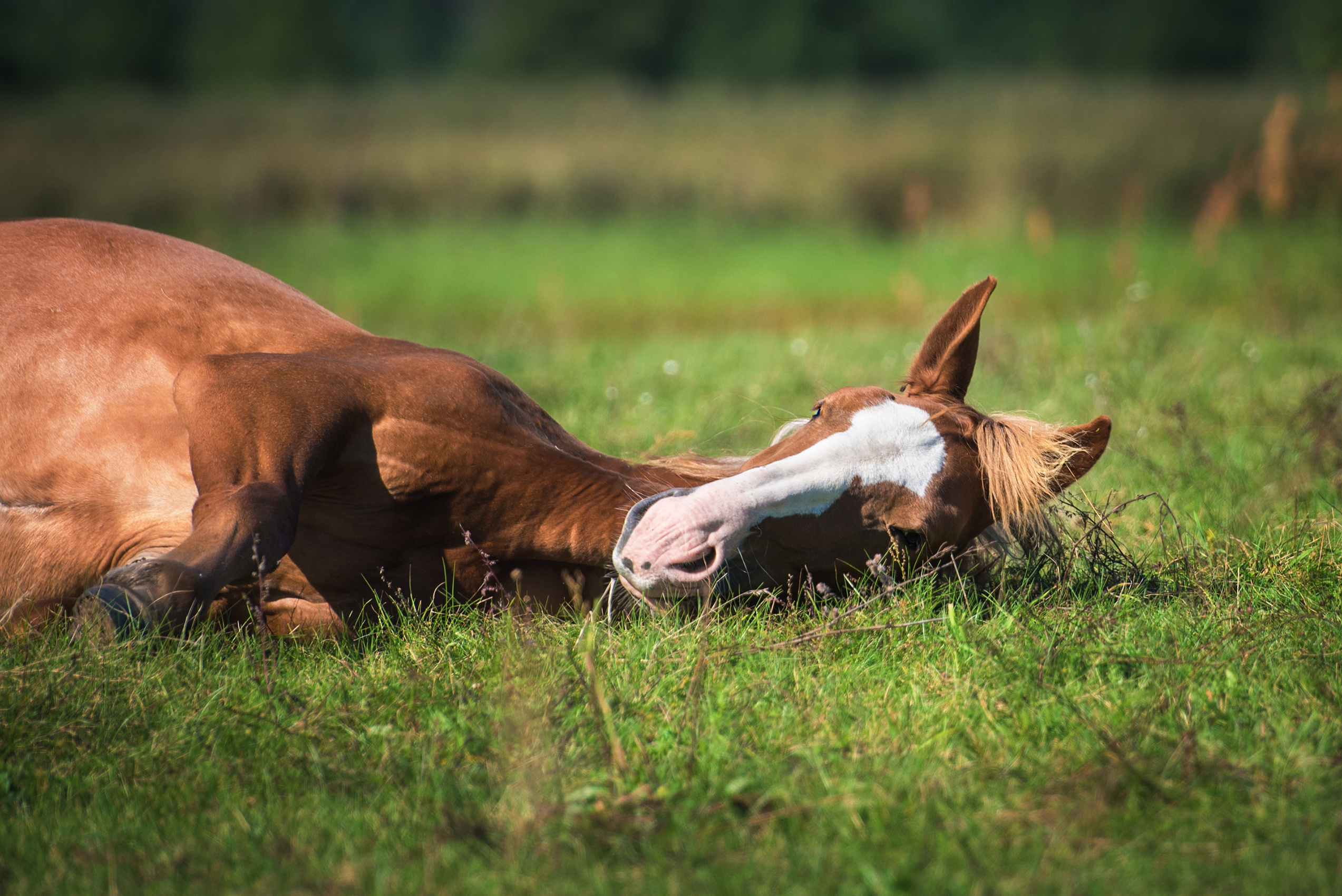
Horses can sleep while standing up because of specialised anatomical adaptations that effectively lock their limbs in an upright position. This is important from an evolutionary perspective because horses are prey animals and need to be able to rapidly flee predators. However, in a group of feral horses, there is always one horse on sentinel duty to detect impending danger while others sleep.
Sleep Differences
Just as in people, there are various types of sleep in horses—drowsiness, slow wave sleep, and rapid eye movement (REM) sleep. REM sleep only occurs when horses are lying down either on their chests (sternal recumbency) or on their sides (lateral recumbency).
Sleep time varies considerably among horses. However, adequate sleep is needed for optimal function and welfare. REM sleep is thought to be particularly important.
Horses rarely lie down for more than about 30 minutes at a time. This might be an adaptation to body size, as horses might be at risk of squashing dependent muscles if they lie down for a prolonged period.
We know when horses are undergoing general anaesthesia, it is vitally important to position them appropriately to avoid squashing upper limb muscles. That can cause major complications during and after recovery from general anaesthesia.
Bedding for Sleep
The quality and depth of bedding are potentially important factors that influence time spent in REM sleep. In one study, horses with rubber matting in the stalls were given bedding depths of 5 cm compared with 15 cm. Less bedding reduced REM sleep in both sternal and lateral recumbency.1
In another study, Nordic horse owners considered hard/dry surfaces and hard/wet surfaces for lying down to be risk factors for sleep deprivation.2
Effect of Light
The effect of light on horse sleep has been investigated.3 Blue-enriched white polychromatic light by day and dim red light at night were compared with a fluorescent light that was manually switched off at night, creating darkness. There were no differences detected for total sleep, lateral or sternal recumbency, standing sleep, and wakefulness between the lighting conditions.
These results imply that dim red light at night does not have an adverse effect on normal sleep patterns compared with darkness.
Sleep and Cognitive Ability
Several studies have tried to investigate whether sleep deprivation results in impaired cognitive ability. One example is the ability to learn and repeat a new task.
These studies have probably been too short. While sleep disruption over a period of six days caused some changes, they were not large enough to be of statistical significance.
However, there might be a biological effect that would be better demonstrated by a longer duration of compromised sleep.
Environment
Most studies on equine sleep have investigated horses in stable environments rather than pasture environments with or without access to a shelter.
Within a stable environment, some evidence suggests it is important for horses to see other horses, preferably when lying down as well as when standing up. The stable should be of adequate size to allow a horse to get up and down without undue difficulty.
There have been no studies that investigated the effects of group housing on sleep.
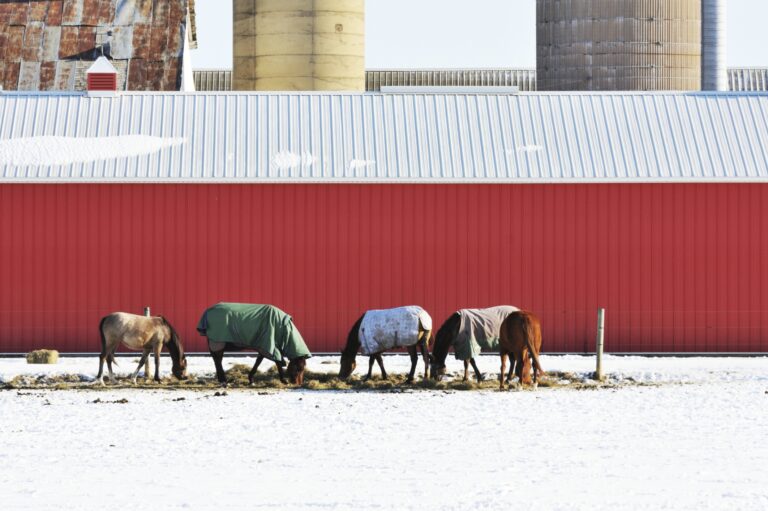
In a recent study, researchers in Europe investigated how horses living in a field used field shelters.4 They observed 53 horses at 20 sites for 72 consecutive hours every month over one year.
On average, horses spent only three hours per day inside, and not consecutively (entering 2.5 times per day).
There was a strong seasonal effect. Horses spent twice as much time in their shelters in summer than in winter. In winter, horses predominantly went into the shelters in the early morning hours (00:00-06:00) to eat and lie down. In summer, they rested standing in the shelter in the afternoon (12:00-18:00).
Larger shelters were used more than small shelters. Shelters with a single access door were used more than open-sided shelters.
There was considerable variation in behaviour among horses so, ideally, they should be free to choose.
Overview
It is common sense that a horse’s ability to sleep—whether stabled or turned out with other horses—might be influenced by having friends close by and not being housed with a horse that is a bully.
Horses are naturally herd animals, and most prefer companionship.
Senior Horses
There is no current evidence that old horses’ sleep patterns are different from other mature horses. However, older horses are more likely to have developed wear and tear injuries that influence mobility through discomfort.
Pain management is critical for senior horses. Pain might make it difficult for horses to get up and down, which could negatively affect their ability to sleep.
The effects of sleep deprivation are discussed in the below video on Horses and the Science of Sleep. This bonus footage comes to you from the producers of Horses and the Science of Harmony. See more in Related Content below.
(Editor’s note: Author Dr. Sue Dyson was executive producer of the film Horses & the Science of Harmony. Dyson, a veterinarian with a PhD, has researched many aspects of equine lameness and behavior. She worked with Padma Video on the above films, and they are now releasing Bonus Footage to help us better understand and manage our horses. You can listen to a podcast with Dyson about Horses & the Science of Harmony.)
Resources
- The effect of altering routine husbandry factors on sleep duration and memory consolidation in the horse. Greening, L.; Downing, J.; Amiouny, D.; Lekang, L.; McBride, S.; Applied Animal Behaviour Science 2021
- Risk factors associated with owner reported sleep disturbances in Nordic horses. Suomala, H.; Brotherus, I.; Hänninen, L.; Ternman, E.; Mykkänen, H. Equine Vet. J. 2025
- Influence of lighting on sleep behaviour, circadian rhythm and spontaneous blink rate in stabled riding school horses (Equus caballus). Greening, L.; Harkin, E.; Kyriazopoulou, P.; Heppelthwaite, Z.; Aragona, F.; Browne, J.A.; et al. PLoS One 2025
- Shelter use in horses: time spent indoors and factors of variation – results from a one-year longitudinal study. Lansade, L.; Lemarehand, J.; Ruet, A. Applied Animal Behaviour Science 2025
Further Content
- My Senior Horse Podcast: Horses and the Science of Harmony. Dr. Sue Dyson. MySeniorHorse.com
- Horses and the Science of Contentment. Dr. Sue Dyson. MySeniorHorse.com
- My Senior Horse Podcast: Sleep Deprivation. Dr. Amy Polkes. MySeniorHorse.com
- Does My Horse Have Narcolepsy or Sleep Deprivation? Dr. Amy Polkes. MySeniorHorse.com
- My Senior Horse Podcast: Equine Behavior. Dr. Kris Hiney. MySeniorHorse.com
- My Senior Horse Podcast: Positive Reinforcement. Dr. Eleanor Girgis. MySeniorHorse.com
- The 24 Behaviors of the Ridden Horse in Pain: Shifting the Paradigm of How We See Lameness. Dr. Sue Dyson with Padma Video.
- Horse Behavior During Tacking and Mounting. Dr. Sue Dyson. MySeniorHorse.com
- Ridden Horse Performance Checklist: Behaviors in Ridden Horses that Might Signify Discomfort. Dr. Sue Dyson. MySeniorHorse.com
- How An Uncomfortable Horse Might Feel to a Rider. Dr. Sue Dyson. MySeniorHorse.com
Sign up for My Senior Horse’s FREE newsletter to get the latest information about equids 15 years and older delivered straight to your inbox!