In Part 3 of this podcast and article series, we learn more about some of the practical ways senior horses, ponies, donkeys, and mules are managed at Redwings Horse Sanctuary. We continue to talk to Drs. Pat Harris and Nicky Jarvis, both equine veterinarians. You can read more about them in their ‘About’ sections below.
Out on Grass, When Possible
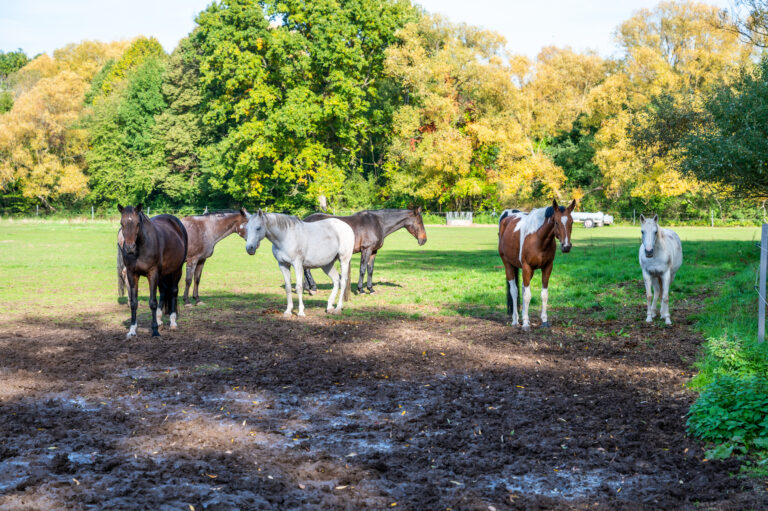
Jarvis said Redwings is very fortunate to have a wide range of facilities for the equids in their care. She said they keep horses at pasture year-round, if possible.
She said with blended groups (different ages and sizes), it’s important to ensure that forage and water are easily accessible to all.
“We have what we would refer to as summer fields and winter fields for each group,” said Jarvis. “The winter fields tend to have enhanced facilities. They have a nice area of hard standing (non-muddy) pad outside and a
generous sort of field shelter.”
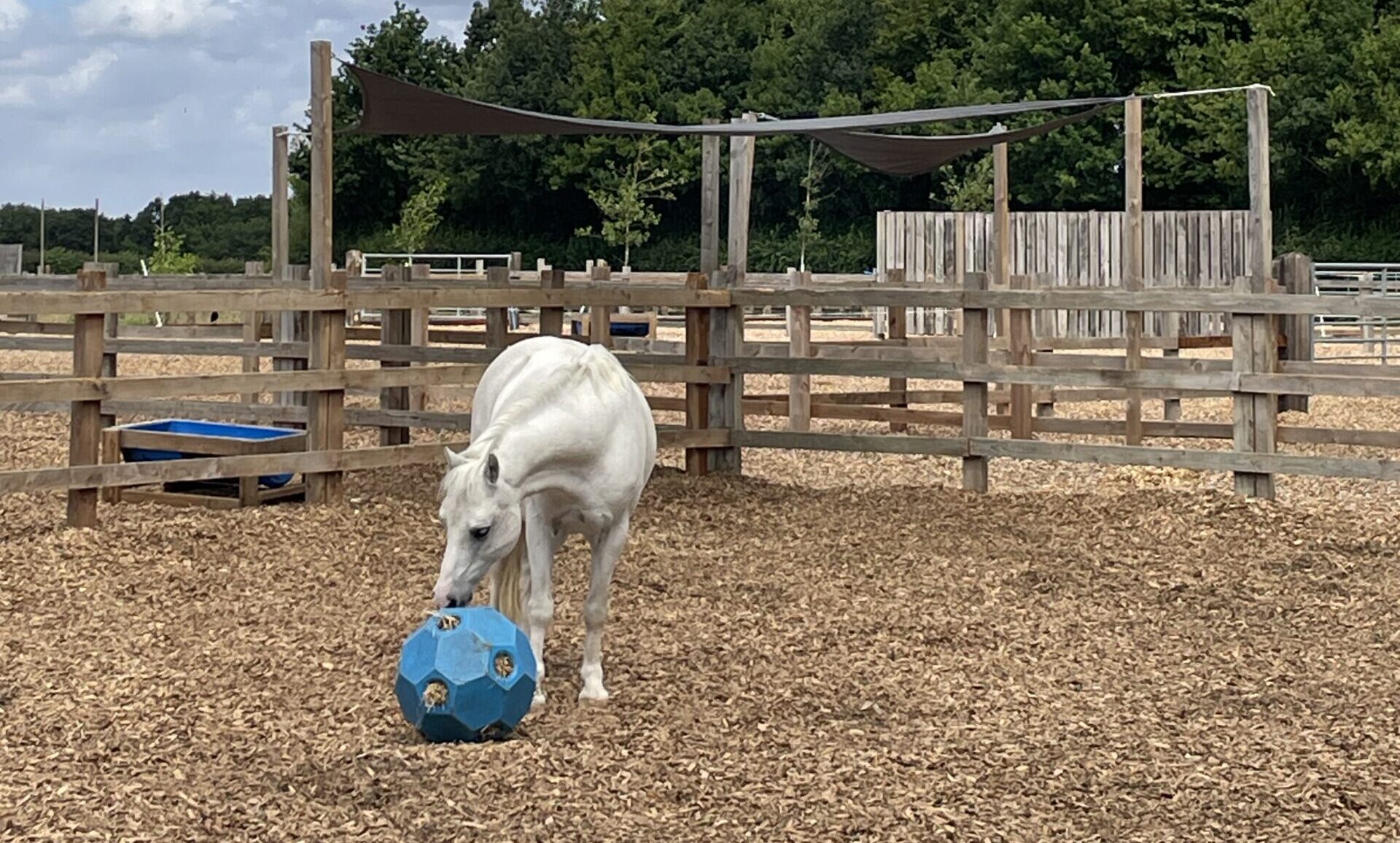
Jarvis said they are also blessed with woodchip paddocks. “Woodchip obviously is quite a wonderful thing if you’re managing groups of older horses,” Jarvis noted. “They wouldn’t spend their whole time on there, but it’s very, very useful for things like weight management.”
She added that the woodchip paddock is also good for a horse that’s been in veterinary care for laminitis and is recovering, or maybe an older horse that’s had to come into vet care for another reason and has low-grade osteoarthritis. (See video and article about Redwings woodchip paddocks in the further reading below.)
“If he’s confined to a box for three or four months, he’s going to potentially seize up (not be as mobile),” she said. “So, again, sometimes managing that horse where it can freely move around and ambulate is really good for the horse’s mental health and often really good to keep those old limbs moving.”
Jarvis added the wood chip paddocks are also very useful in winter to provide an area of mud-free good footing.
(Check out The Benefits and Uses of Woodchip Paddocks.)
Creating Groups
It’s important to support the mental as well as the physical aspects of older horses in herds, said Jarvis.
Redwings’ staff work very hard to keep friends together in groups if possible, said Jarvis. “It’s very rare we would divide them up.”
Sometimes a senior horse will have physical issues that might mean it has to be moved to a different management group.
“We would try and work to find solutions to the problem,” said Jarvis. “For example, if one horse needs an extra feed and the other one doesn’t, we would feed the one separately in a corral in the field or in the shelter.”
She said it is “surprisingly seldom” that the staff has to move horses to different groups.
“I think the one major time it would happen is if we had an older horse with very failing dentition that was suffering from episodes of colic and choke,” she noted. “If we deemed that horse couldn’t be around long-fibre forage such as hay any longer, we would then potentially look to relocate the horse to a group of what we call ‘no long-fibre ponies.’ Now again, we’re very blessed. We have several groups of no long-fibre ponies, so we can at least match and find a really good friend.”
(Editor’s note: See Part 1 of the podcast for more information on introducing a horse to a new group.)
“But their mental health and well-being are critical,” stressed Jarvis. “It’s critical in these older horses. I really believe it is. And I’ve seen horses that have lost companions where literally they won’t eat and they barely sleep. So, I think you’ve got to think long and hard before you radically divide up a bonded pair.”
Feeding-Time Company, or Not!
Harris noted that some horses actually will eat better if there’s another horse around, but other horses eat better when they’re alone because otherwise they’re too on edge. (This can be from fear of competition.)
She said in the same way, some older horses like to be in a busy yard (stable), and others don’t.
“Some of them are actually very stressed by everything going on around them,” explained Harris. “They’re used to being out in that field where they can hide with their mates in a corner and just move around. And suddenly they’re in this yard where there’s noise and there’s people and everything’s going on and strange horses are moving.
“So, I think it’s worth thinking about the individual and where to house them,” she said.
Harris reminded that if a horse is restricted for some reason, you need to think about any changes in feeding. “What do you need to do with their food if they were on certain feed that was providing additional calories, now they’re not moving around?” she posed. “Do you need to reduce that? How do you do that and still keep that fibre?”
She said considering all of these management issues is important even if the horse is moved for only a short period of time.
Many Types of Horses
The question was raised about differing backgrounds and personalities of horses that come into Redwings. This could be similar to issues faced by an individual buying a senior horse.
Jarvis said they intake a wide range of horses, including those that are nearly feral with little human interaction. She said with those, it is important to try and keep them with their herd, if possible.
“You may have a horse come in and perhaps that horse has lived in pure isolation on its own for many, many years,” she said. “It’s quite aged, it’s had minimal veterinary intervention or care, and also it’s had no socialisation from other horses. The horse hasn’t even got the protection of having a herd with it. It’s lived on its own. So, everything can be quite a big culture shock when the horse comes in.
“But, we are blessed,” she added. “Our behavior teams will work really hard to find a group the horse can join, a group it feels comfortable with. And we’ll get it to a stage where we can complete all of the necessary veterinary treatment we need to do to keep the horse safe, to keep it well. But, equally, not to put any undue stress on the horse. And obviously all of the handling that is done is very much done using humane techniques and positive reinforcement. And it’s all done at the horse’s pace.”
She noted that while Redwings does rehome horses to wonderful guardian homes wherever possible, the organization is also a sanctuary. So, horses with medical or behavioral challenges that cannot be rehomed can live out their lives on one of Redwings’ special care farms.
Room to Move
Both Jarvis and Harris emphasized the importance of giving horses enough room to move around and self-exercise.
“We’ve done some work to show that even a short period of trot a day can really help to support a reduction in insulin resistance or improvement in insulin sensitivity,” said Harris. However, she added that, “exercise is really important if you can, but some animals you can’t because of osteoarthritis and other reasons. So, I think we have to work what’s right for the individual.”
Harris mentioned that while a pasture with a sloping hill might be great for younger horses to strengthen their bones and joints, it might not be suitable for older horses that possibly have mobility issues.
She also advised that pastures with senior horses should have feeding and watering areas that do not put additional stress on the musculoskeletal system. That means ideally, they are not too muddy.
(Editor’s note: Make sure to listen to Part 1 and Part 2 of this podcast and check out the articles on My Senior Horse.)
About Dr. Pat Harris
Dr. Pat Harris is a past president of the British Equine Veterinary Association and is a European specialist in veterinary and comparative nutrition. She is the Equine Nutrition and Science advisor to Mars Horsecare & WALTHAM TM Equine Studies Group, Waltham Petcare Science Institute. Harris has spent much of the last 30 years working to help improve the care and nutrition of older horses. She also is passionate about seniors because of her dedication to her own older horses. Harris has advised on the care of many senior equids and has authored numerous articles on their care. Her involvement in several global senior research teams gives her special insight into some of these studies. Harris is also on the Executive Advisory Council for My Senior Horse.
About Dr. Nicky Jarvis
Dr. Nicky Jarvis is head of Veterinary and Care at Redwings Horse Sanctuary in Norfolk, England. She qualified from the Royal Veterinary College, London, in 1990 and worked in mixed practice for two years before moving to Newmarket, where she completed a two-year internship at Rossdales Equine Hospital. Dr. Jarvis then joined Redwings Horse Sanctuary in Norfolk in 1996. She is now head of Veterinary and Care, working with what she calls an “incredible” team of veterinary surgeons and nurses to care for more than 1,200 resident horses, ponies, donkeys, and mules. Dr. Jarvis attained her RCVS Certificate of Advanced Veterinary Practice in Equine Medicine in 2012 and her CertAVP in Equine Surgery Soft Tissue in 2013. She has a keen interest in equine nutrition, geriatric medicine, internal medicine, and colic.
Further Content
- My Senior Horse Podcast: Managing Senior Herds Part 1. Kimberly S. Brown. MySeniorHorse.com
- My Senior Horse Podcast: Managing Senior Herds Part 2. Kimberly S. Brown. MySeniorHorse.com
- All the My Senior Horse podcasts can be found listed here.
- Learn more about routine care of senior equids in these articles.
- See articles about senior horse dental care here.
- Ethically Restricting Feed Intake for Horses. Liane Preshaw and Dr. Edward Knowles. MySeniorHorse.com
- Senior Horse Fitness: A Balancing Act. Colby Bolger. MySeniorHorse.com
- Feeding Horses That Can’t Eat Long Fiber. Alex Beckstett. MySeniorHorse.com
- What You Should Know About Equine Osteoarthritis. MySeniorHorse.com
- My Senior Horse Podcast: Horses and the Science of Harmony. Dr. Sue Dyson. MySeniorHorse.com
Sign up for My Senior Horse’s FREE newsletter to get the latest information about equids 15 years and older delivered straight to your inbox!