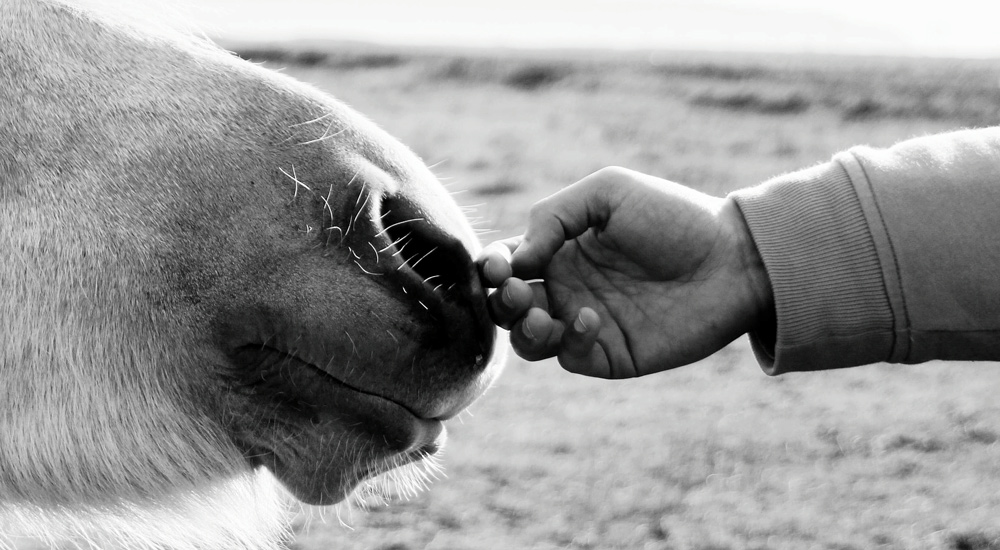
Recently published research1 from Sweden looked at whether horses prefer their owners over strangers. While the researchers call the results “speculative,” it’s interesting that equids possibly ‘generalize’ some of their relationships with humans.
The Reunion Test
First, the researchers wanted to see if horses would show a bias toward their owners during a reunion in the presence of both the owner and a stranger.
Each horse and owner pair must have been together for at least a year in order to participate in the study. The duration of the animal’s ownership ranged from one year to 18 years. The stable where the animal was kept needed an accessible indoor riding arena nearby. Two indoor arenas were used.
Thirty privately owned horses and their owners (29 females and one male) volunteered to participate in this study. The horses included in this study consisted of 15 mares and 15 geldings, aged 4-31 years.
The reunion test was performed in a mini arena measuring 14 × 20 meters (46 x 66 feet). This mini-arena was created in the indoor arenas. Cameras were used to record the horses’ behaviors.
How the Test Worked
Three mini marker cones were placed in the arena to mark the standing points for owner and stranger during the reunion test. One mini marker cone was placed in the middle of the arena while the mini marker cones were placed 2.5 meters (about 8 feet) away from it on each side.
The horse was led by its owner to the middle cone, where they remained stationary for one minute while instructions were given to the owner. The owner then released the animal, and both the owner and the experimenter (acting as the stranger) exited the indoor riding arena. The experimenter had prior experience with horses but had not previously met any of the animals participating in the study.
The horse was left alone in the arena for 1 minute. The owner and the experimenter re-entered the arena and walked together to the middle marker cone. Then they separated and walked to the marker cones to the right and left of the middle marker cone.
For three minutes, the owner and experimenter stood passively and did not interact with the horse.
Afterwards, the animals were also presented with the odor of the owner and a stranger. Both tests were video recorded for behavioral analysis. Researchers wanted to see which human the horse got close to or touched.
Reunion Results
Two of the 30 horses were excluded because they were already standing at the cones where either the owner or experimenter were assigned to approach when reentering the arena. Of the 28 remaining animals, 12 approached the owner first (eight mares and four geldings), while 10 approached the stranger first (three mares and seven geldings).
Only half of the horses chose to walk up directly to the owner to reunite first.
“These results may indicate that the human-horse relationship, as perceived by the animal, differs from that typically found between dogs and their owners,” noted the researchers. “Although horses are indeed highly social animals, they live outside the household unlike dogs. Therefore, it is possible that horses experience stronger separation distress when separated from conspecifics [other horses] than from humans.”
They also noted, “We found no association between the owner bias for head proximity and the length of the horse-owner relationship in the present pilot study. However, relationship length showed significant effect on owner bias for physical contact, although this result should be interpreted with caution due to the limited number of contacts observed.”
The Odor Test Preparation
The research said one to two weeks prior to the odor test, the participants were provided with a new T-shirt and neutral soap by the experimenter. They were instructed to wear the T-shirt to bed five consecutive nights. Participants showered before bed using the provided neutral soap. In the mornings, participants placed the T-shirt in a Ziploc bag each morning. Participants were instructed to avoid using any other personal soaps or perfumes to minimize contamination of the odor sample.
The T-shirts were collected and stored at −20°C until the day of the behavioral test. Shirts were cut in half using disposable gloves This allowed owners from one stable to act as strangers to horses in another stable.
Prior to the odor test, each horse was trained to approach a single bucket containing pieces of carrots, which was placed at the back end of the smaller odor experimental arena (5 x 5 meters or about 16 x 16 feet).
The Odor Test
Each owner was instructed to lead his or her horse to the bucket the first three times. Each time, owners allowed the horses to eat slices of carrots from the bucket. During the next two trials, the owner was instructed to stop halfway to the bucket and allow the horse to approach the bucket on its own. During the sixth and seventh time, the owner let the horse loose at the starting point, allowing it to approach the bucket on its own.
When the horse would approach the bucket on its own two times in a row without delay, the odor test was performed immediately.
For the odor test, two plastic buckets with wire netting were placed in the back end of the arena. One bucket contained half of the owner’s Tshirt, and the other bucket contained half of the stranger’s T-shirt.
Odor Test Results
The bucket containing half of the owner’s T-shirt was placed either to the right or to the left, with the side being randomized for each horse. The horse was led by the owner to the starting point. It then was allowed to approach the buckets on its own.
The horse’s behavior was video recorded, and the first 3 minutes were analyzed using a predetermined ethogram. The starting point was between two jumping stands located 5 meters away from the buckets.
While 28 horses participated in the odor test, only 27 horses completed the test. In the test, 27 horses got muzzles close to at least one bucket, and 25 touched one bucket. Researchers found that older horses showed a stronger owner bias of getting their muzzles close to the owner’s bucket than younger horses.
The researchers noted, “Previous studies have shown that younger horses tend to explore more than older horses, and Rørvang et al. found that younger horses sniffed more at unfamiliar odors compared to older horses.”
There also was thought that the pre-training with carrot slices in the buckets could have developed anticipation of carrots. That could have made them less interested in human odors and more focused on searching for carrots.
They also noted that in the odor test, the owner was present during both the training and testing phases to avoid another separation that could stress the horse. “However, the owner’s presence may have unintentionally reduced the horses’ interest in the bucket containing the owner’s odor, potentially masking any owner bias.”
Conclusion
“In this pilot study, we found no evidence of owner bias at the group level in either the reunion test or the odor test,” the researchers wrote. “These results suggest that horses may generalize aspects of their relationship with their owner to unfamiliar humans, although this interpretation is speculative given the small sample size and exploratory nature of the study. Our findings contribute to the growing body of research indicating that the horse-human relationship is complex and may differ from that of other companion animals, such as dogs.”
Reference
Horses show limited owner bias in reunion and odor tests: a pilot study. Journal of Equine Veterinary Science. 2025. Ellinor Rönnow, Lina S.V. Roth.
Further Reading
- Ridden Horse Performance Checklist: Behaviors in Ridden Horses that Might Signify Discomfort. Dr. Sue Dyson. MySeniorHorse.com
- Additional Behavior and Musculoskeletal Pain Signs in Ridden Horses. Dr. Sue Dyson. MySeniorHorse.com
- How a Comfortable Horse Should Appear During Ridden Exercise Part 1. Dr. Sue Dyson. MySeniorHorse.com
- How a Comfortable Horse Should Feel During Ridden Exercise Part 2. Dr. Sue Dyson. MySeniorHorse.com
- Horse Behavior During Tacking and Mounting. Dr. Sue Dyson. MySeniorHorse.com
- Horses and the Science of Contentment. Dr. Sue Dyson. MySeniorHorse.com
- My Senior Horse Podcast: Horses and the Science of Harmony. Dr. Sue Dyson. MySeniorHorse.com
- My Senior Horse Podcast: Equine Behavior. Dr. Kris Hiney. MySeniorHorse.com
Sign up for My Senior Horse’s FREE newsletter to get the latest information about equids 15 years and older delivered straight to your inbox!