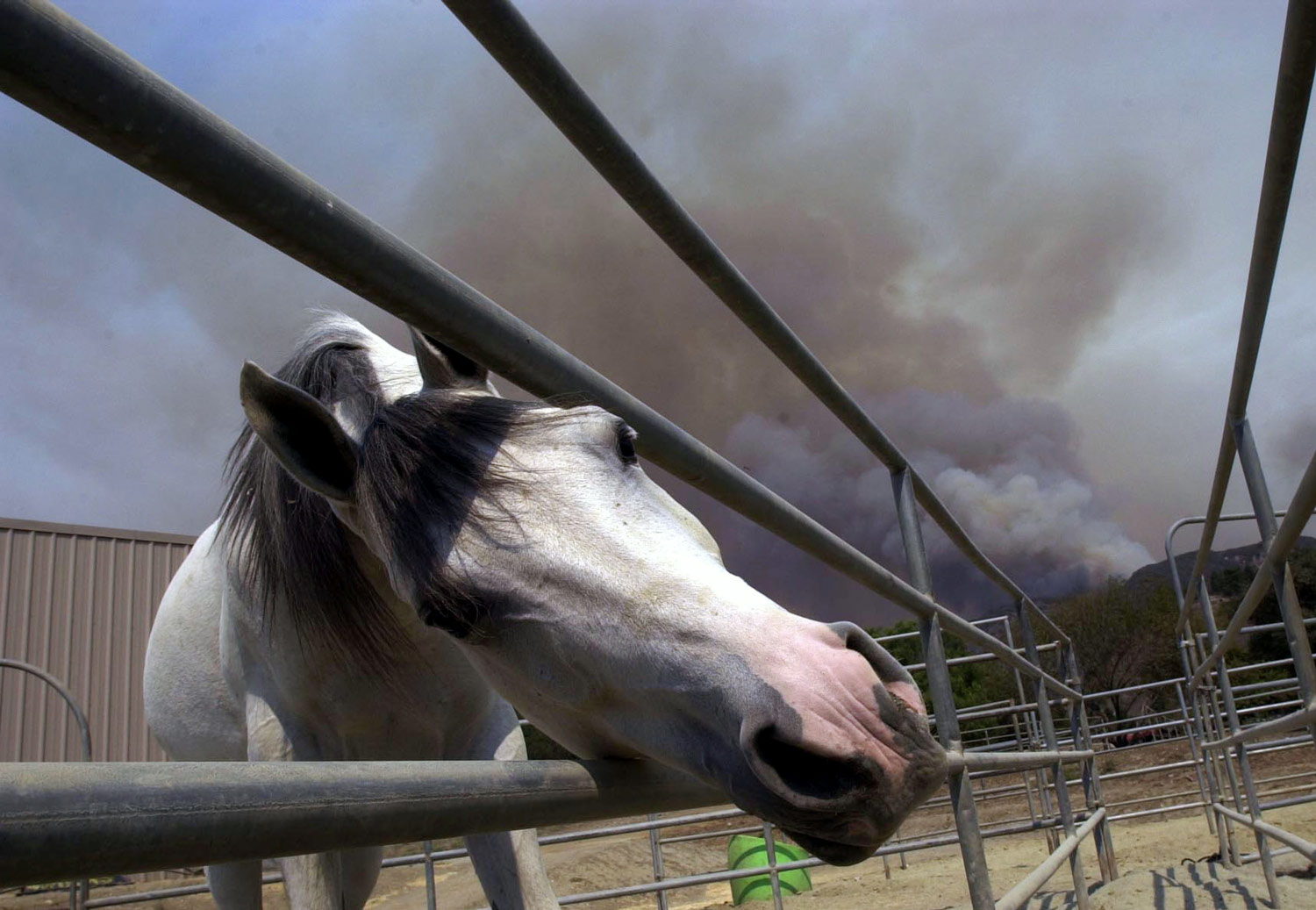
Wildfires can occur in almost any area, but there are certain environments that are more prone to wildfires. No matter your geographic location, if a wildfire is possible in your area, follow these steps to prepare.
Quick Facts
- The safety of you and your family should be the first priority.
- The greatest factor in limiting your losses during a wildfire is having and using a preparedness plan.
- An emergency equine first aid kit is essential: Keep one in the barn and one in the trailer.
- Prioritize a list of tack to take during an evacuation.
- Start evacuation plans immediately when evacuation orders are given.
Along many roads in fire-prone regions of the U.S., you might see signs indicating the “Fire Danger Rating” level. Wildfire likelihood increases dramatically when the fire danger is moderate to high. It’s higher when combined with a large number of dead trees in forested areas. Be prepared to protect your horses if you live in a high-risk area. They need your help and planning.
First, you must assess your risk. Consider your location and your local situation. Knowing your risk will help you prepare your plan.
Having a plan and implementing that plan is the greatest factor in limiting your losses. With equids, we are not only speaking of monetary loss, but also the emotional loss of your horse. That is impossible to calculate in dollars and cents. Communicate your plan to everyone living with you or to anyone who will be taking care of your property in your absence.
Following are key elements of a wildfire preparedness plan.
Be Prepared
An evacuation plan for yourself and your horse(s) is a major part of being prepared. You cannot wait until you see smoke or fire to make the decision to evacuate and determine your evacuation route(s).
Horses need your help to survive a wildfire. Just turning a horse loose to fend for itself is not a great solution. However, there are situations where there is imminent danger to you and your horses. In that case, it is better to turn your horses loose instead of leaving them confined to a barn or pasture.
Evacuation Routes
Contact your local emergency management officials, county law enforcement officials, or animal control officers to plan an evacuation route. Find out what they recommend and what procedures they have in place for disasters.
Make plans for more than one evacuation route in case the wildfire cuts off one of your exits. Prioritize the routes if you have the choice.
Drive all the evacuation routes with your horse trailer. The exit routes must pass the questions of: Can I get out with my size of trailer? Is it passable in all weather conditions? How would the routes be affected if there were flooding and a wildfire at the same time?
In some areas, you can have wildfires raging at the same time that flooding is occurring.
Be aware of dangerous fire conditions in your area and know how to find information on potential conditions or situations.
Trailer Ready
Have your trailer in good condition and available to hitch up and load at any time. Keep a full tank of gas in the vehicle that you will use for towing the horse trailer. Train your horses to load any time of day or night. In case of emergency, only one person might be available to load horses.
If you do not own a trailer, work with a neighbor who does. Create a plan to get help evacuating your horse.
It’s good practice to load your horse in the trailer you will be using to evacuate.
Team up With a Neighbor
Develop a team plan with a neighbor. This could help in the joint use of resources such as a trailer and supplies.
It also helps to outline a joint plan. Inform each other in the case of an evacuation. Working as a team, you will be better able to efficiently evacuate in a shorter amount of time.
Horse Identification Packet
You must be able to identify your horse. If you take your animals to a fairgrounds or other public facility, you need definitive identification. The same is true if you had to turn your horses loose.
Horse identification can be microchips, brands, pictures, unique markings, registration papers, brand papers, or a combination of these. Make a packet for each of your horses. Have it readily available to take with your horse in case of emergency. In that packet have your health certificates, brand paperwork, vaccination records, and other health information.
Identification papers enable you to claim your horse more quickly. It also prevents someone else from falsely claiming your horse. In most cases of a major disaster, documentation of ownership will be required to claim a lost horse.
In situations where your horse has been lost, the legal entity in most communities to work with is the animal control agency, which is usually under the law enforcement division of that county.
For example, in Colorado most livestock identification and ownership issues are under the jurisdiction of the Colorado Division of Brands, part of the Colorado Department of Agriculture.
States With Brand Inspection
It is important to note that in states that have brand laws, brand inspection is required for horses any time an animal is sold, transported more than 75 miles, or leaves the state.
Even if your horse does not have a brand, a brand inspection is required. A permanent travel card can be obtained from your local inspector that eliminates the need for future brand inspections when moving your horse.
In addition, “any time livestock is to be transported on a public road, proof of ownership of the stock being transported must be available for inspection by the Colorado State Patrol, local law enforcement, or a livestock inspector. If the animal carries your Colorado brand, this can be your proof of ownership. Failure to show proof of title is a misdemeanor.” (This can be found in C.R.S.35-53-117, Colorado Dept. of Agriculture, Brand Inspection Board web site.)
Having a permanent travel card or brand papers will aid in claiming your horse and in meeting brand laws concerning movement of horses.
Equine First Aid Kit
A well-stocked equine first aid kit is essential for all horse owners to have in the barn and trailer. Both kits need to be routinely checked and kept up to date.
If possible, clearly label all horse medications and keep them in an appropriate container that can be quickly located and loaded in emergencies.
Tack
Prioritize a list of tack to take during an evacuation. Consider keeping a copy on your phone.
With a list, you are more efficient and do not have to take time to plan or decide what to take. The most important tack to remember are ropes and halters. Leather or rope halters are preferred because nylon halters can get hot and melt if the horse gets too close to a fire.
Include a water bucket on your tack list. Prepare neck bands for your horses on which you have contact information. These neck bands would be used in an emergency evacuation in which you only have time to turn your horses loose.
Another option is to create an identity halter that has a metal or brass plate riveted to a leather halter. You can also have metal dog tags made for this purpose. Suitcase identification tags also work well when filled out and kept in the tack room for quickly attaching to halters. Of course, these items should be prepared ahead of time.
Boarding Arrangements
It’s important to make arrangements for boarding your horses at an outside facility in case of emergency.
During a major disaster, the county fairgrounds might be the appointed shelter for livestock, horses, pets, and maybe even displaced people. You can also make plans with friends who have equine facilities that are located out of harm’s way. Or you could use a large commercial boarding facility.
The important point is to have a place lined up to take your evacuated horse(s). There might need to be more than one evacuation location depending on the receiving facility’s capacity. Make sure to include these evacuation locations on your evacuation routes.
Write down your arrangements and the list of your contact people and stick it on a clipboard that hangs in the barn.
Contact List
It is best to have an outside contact of someone who lives in a different area of the country to be the clearinghouse for calls from your family and friends. You can make contact with the clearinghouse by whatever means possible. They can relay information to others.
By appointing a contact who lives outside of your area, they are less likely to be affected by the disaster area’s possible failures of infrastructure and communications. Other family members from around the country can check in with them to get an update on your condition. Your contact can relay messages from you to them or vice versa.
In a disaster situation, you will be very busy with evacuation and might not be able to be reached due to failures of communication lines or cell towers. Place these contact numbers on another clipboard in the barn. You can also use this contact list clipboard for other important phone numbers such as your veterinarian or sheriff.
Another place to post your contacts is in your cell phone address list. However, it is best to have a written form available in the barn. If first responders come to your place and you are not home, the contact clipboard will provide valuable information to them.
Priority List
Once you have made your plan, you need to prioritize it. This helps you during an actual emergency or helps others in the event that you are not home at the time.
Even though it is hard to think about, priority is given to people over horses. So, on your priority list, keep human safety as your guiding principle.
If you have a two-horse trailer and you have five horses, a priority list must be made. Or maybe you have limited time because of a rapidly advancing fire, so priorities must be made on what you will have time to do. You can also keep this list on your contact list clipboard in the barn.
Below we talk about priorities during a disaster.
Safety
The safety of you and your family should be priority number one! That cannot be emphasized enough.
If you get word that your area is being evacuated, start the process immediately. Wildfires are very unpredictable and can spread rapidly.
As soon as you get word of a forced evacuation, begin to implement your evacuation plan, as sometimes loading horses and other necessary tasks will take longer than you expect. This is especially important if you have multiple horses and other animals to evacuate.
Contact your neighbor if you are working as a team. Get in touch with your outside contact to give them your status.
If the fire is close and you are unable to get your horses out, do not leave them confined. After getting them out of the barn or pasture, close the doors or gates. Horses in danger will often seek the comfort of the known–their pastures and stalls.
Also keep in mind that your horse in the face of danger might not react to you the same as they usually do. Use caution as their instincts might take over. They might be in flight or fight mode. If possible, have someone help you handle the horses.
If you have not had your horses permanently identified in some way such as microchips, brands, tattoos, or photographs, then paint your cell phone number or the last four digits of your social security number on the horse. Place your identity halter on your horse (if you’ve prepared it ahead of time).
If you only have nylon halters, remove them. If your horses get too close to an actual fire, nylon halters get hot and can cause skin damage. If you have time, try to lead your horses away from the buildings before releasing them to encourage them to move away from the buildings and the impending fire.
Summary
Having a plan is the most important way to prepare for the wildfire season.
Remember to:
- Plan.
- Practice the plan.
- Place people’s safety first–that includes your own!
N. Striegel, DVM, former Colorado State University Extension 4-H and livestock agent, Boulder County, is the original author of this edited press release.
References
- Colorado Community Animal Response Training: Distributed by Colorado State Animal Response Team, a program of the Colorado Veterinary Medical Foundation.
- American Association of Equine Practitioners; Horse Health Education: Disaster Preparedness
- Colorado Department of Agriculture Brand Inspection Board Web Page: When to get an Inspection. (2008). From www.colorado.gov/cs/Satellite/Agriculture-Main/CDAG/1176829158611
- FEMA Emergency Management Institute’s Course #IS-10, Animals in Disaster, Module A: Awareness and Preparedness. http://training.fema.gov/EMIWeb/downloads/is10comp.pdf
Further Reading
- Tips for Hauling Horses Safely. Dr. Nancy Loving. MySeniorHorse.com
- Equine First-Aid Kit. MySeniorHorse.com
- Flooding Risks to Horses. MySeniorHorse.com
- Equine Bandaging Basics. Dr. Nancy Loving. MySeniorHorse.com
- Icing Tips for Horse Owners. Dr. Nancy Loving. MySeniorHorse.com
- Does an Equine Leg Wound Need Stitches? Dr. Nancy Loving. MySeniorHorse.com
Sign up for My Senior Horse’s FREE newsletter to get the latest information about equids 15 years and older delivered straight to your inbox!