Very small quantities of black walnut wood residue can incite laminitis in horses. Purdue University has a downloadable PDF that can help you avoid this issue when you are buying shavings for bedding.
Small Quantities, Big Issues
The Purdue information stated that, “As little as 10% of the total shavings, by weight, may result in clinical signs of toxicity in horses. These signs generally occur within 24 to 48 hours of exposure to the contaminated shavings. Since the lowest amount that can cause toxicity has not been established, the safest course is to make certain that there are no black walnut shavings used as bedding for horses.”
The article went on to state that, “Clinical signs in affected horses can range from minimal to extremely
severe within the same group. The symptoms frequently begin with mild laminitis and swelling of the legs and can progress to extremely severe laminitis, swelling, and edema of all four limbs; and pitting edema of the ventral abdomen; and colic. In extremely severe cases, the laminitis can be severe enough to allow rotation of the coffin bone leading to loss of the animal. When multiple horses are present in a single stable, there can be significant variation in the degree of laminitis and edema among individuals.”
Check Bedding for Color
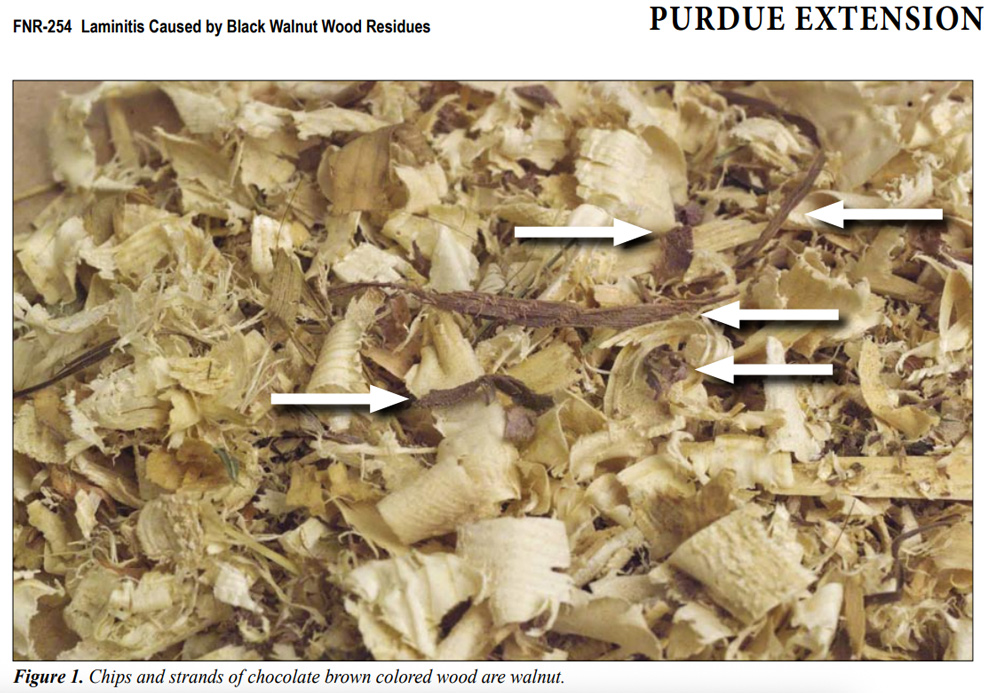
Fortunately, walnut heartwood has a very characteristic and near unique chocolate brown color. The color is due to an abundance of water soluble extractives in the wood.
The accompanying image (courtesy Purdue Extension) shows a sample of shavings of which only a small portion is walnut. However, it still was enough to have caused laminitis in this case. The dark pieces are easily identified.
A hand lens can be useful for closer study. But if the bedding is composed of sawdust, it is almost impossible using visual techniques to determine if walnut residues are present.
Reference
Laminitis Caused by Black Walnut Wood Residues. Purdue Extension. Daniel L. Cassens, Professor and Extension Wood Products Specialist in the Department of Forestry and Natural Resources, and Stephen B. Hooser, DVM, PhD, DABVT, Head of Toxicology Section and Assistant Director, Animal Disease
Further Content
- Recognizing the Early Signs of Laminitis in Horses. Alexandra Beckstett. MySeniorHorse.com
- Pasture and Obesity Effects on Pony Laminitis Risks. Kimberly S. Brown. MySeniorHorse.com
- What is Equine Laminitis? Dr. Nicola Menzies-Gow. MySeniorHorse.com
- Feeding Horses and Ponies Prone to Laminitis: Part 1. Sarah Nelson. MySeniorHorse.com
- Feeding Horses and Ponies Prone to Laminitis: Part 2. Sarah Nelson. MySeniorHorse.com
- Assessing Your Animal’s Risk of Laminitis. Dr. Ed Knowles. MySeniorHorse.com
Sign up for My Senior Horse’s FREE newsletter to get the latest information about equids 15 years and older delivered straight to your inbox!