Yesterday, your senior horse seemed fine. But this morning, he’s leaning backward in the stall to keep weight off his front feet. Or maybe he’s hobbling along in the pasture, clearly footsore in front.
It might feel like laminitis just cropped up overnight. And actually, in some cases, that might be true. Horses can go from disease-free to outright lame over a period of weeks or in as few as 18 hours, says Chris Pollitt, BVSc, PhD, head of the Australian Equine Laminitis Research Unit at the University of Queensland.
But regardless of how long laminitis takes to manifest—or what initially caused it—the illness tends to follow three key stages, he says.
In this article, we’ll walk backward through those laminitis stages, from when it’s most obvious and destructive to when it all started. Each stage reflects a different level of damage to the lamellae (the interlocking tissues that suspend the distal phalanx, or coffin bone, within the hoof capsule) and to the horse as a whole.
While we’re focusing on three distinct stages, Pollitt says it’s important to keep in mind that seniors with equine metabolic syndrome (EMS) might have overlapping phases. That’s due to fluctuating blood insulin levels that keep horses moving in and out of risk between chronic and acute phases of hyperinsulinemia-associated laminitis (HAL).
The Chronic Stage
“Chronic” often conjures the idea of “lasting forever,” but that’s not necessarily the meaning in this context, Pollitt says. Certainly, laminitis can be chronic in the sense that it lingers long-term, especially if treatment is inadequate or arrives too late.
But technically speaking, the chronic stage of laminitis is the one marked by so much structural failure that the distal phalanx moves. By this phase, the lamellae have weakened to the point they can no longer hang the distal phalanx in its proper place, and the hoof-shaped bone—following the laws of gravity and the loads of weight-bearing and locomotion—sinks downward. In extreme cases, the phalanx can pierce through the horse’s sole, introducing infection into the hoof capsule.
In this stage, damage to the inside of the foot, especially the microscopic structures of the lamellae, is “catastrophic,” Pollitt says. “There are massive cellular changes, destruction of the bone (osteolysis) of the distal phalanx, proliferation of the damaged epidermis—really a whole range of things is happening, on top of all of which is pain, because the bone is crushing that sole.”
The chronic phase can last “forever,” eventually leading to long, misshapen feet, crippling pain, and miserable quality of life, Pollitt says. But chronic stages also occur in mild disease. “In that case, the lamella repair to some extent and may draw the bone back into a relatively normal position, and it’s all over,” he says.
The Acute Stage
The hallmark of the acute stage is the first appearance of clinical signs, Pollitt explains. That includes lameness and back-tilted standing with the forelimbs camped forward, as well as also more subtle things like weight-shifting, picking the feet straight up instead of breaking over during movement, and exaggerated lameness when asked to turn sharply while being hand-walked.
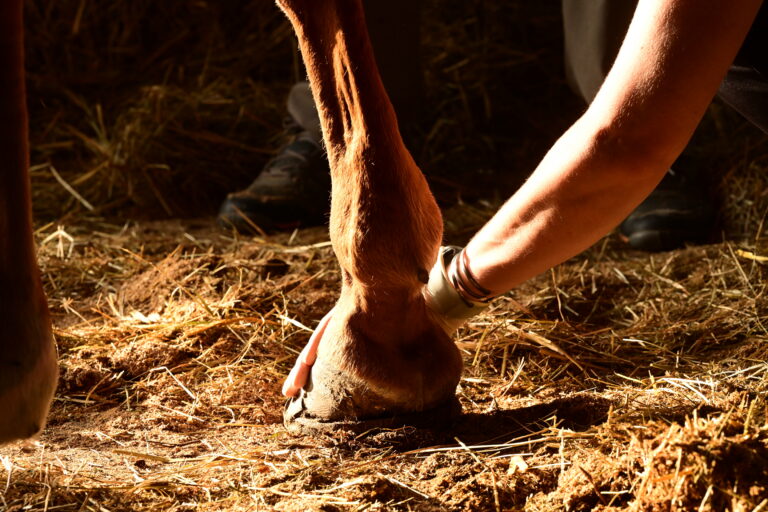
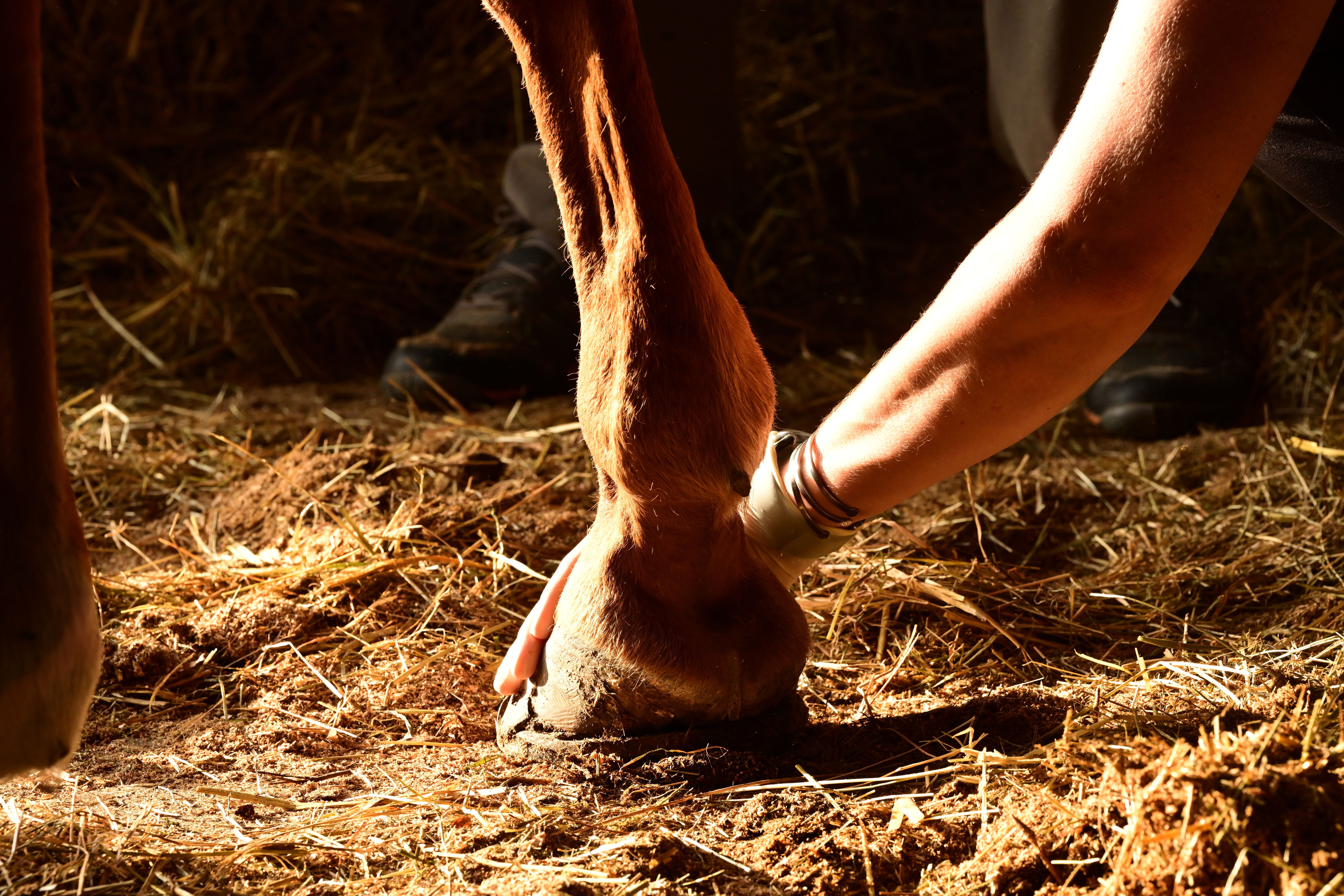
“A led horse may pull you off the hardtop or concrete path to walk more comfortably on the soft grass or sand beside,” he says. Digital pulses also tend to feel stronger in the acute stage (and continue into the chronic stage), and the hooves get warmer to the touch.
Inside the hoof, stress on the compromised lamellae are causing them to fail, Pollitt says. The horse begins to feel pain, but the coffin bone is still in its rightful place, as X-rays can confirm.
The acute stage marks a turning point: The disease can either continue progressing toward the chronic phase, with the coffin bone sinking, or it can stop and resolve. That depends almost entirely on the magnitude of the inciting causal factors, says Pollitt.
“If you know the cause, and you’re quick on reversing that (e.g., normalizing blood insulin), you might get the horse through the acute ‘sore foot’ phase and end up with a relatively normal foot,” he says.
In senior horses, the cause of laminitis is often metabolic disease—whether from too much food and not enough exercise or the consequences of pituitary pars intermedia dysfunction (PPID). Cutting starches and sugars—including carrots—from the diet (”Sorry, but no more treats,” Pollitt urges) to reduce insulin levels and starting the horse on a graded exercise program (e.g., with fenced tracks to water and feed) and non-steroidal anti-inflammatories (NSAIDs) if needed initially can help promote recovery, he explains.
A newly developing class of drugs is also promising for these horses, Pollitt adds. Recent research shows that sodium-glucose co-transporter 2 inhibitors (SGLT2is, initially designed for managing human diabetes) such as velagliflozin and ertugliflozin can dramatically reduce serum insulin concentrations in insulin-dysregulated horses. “Horses that were footsore and miserable last week move freely this week,” he says. “The use of the ‘glifozins’ has revolutionized the treatment of laminitis.”
Still, what happens inside the foot during such interventions remains a mystery, he explains. Because of ethical limits on equine research, scientists don’t experiment with inducing horses to the painful acute phase just to open up their hooves and peek inside. Such limits protect research horse welfare but leave a critical knowledge gap. “With HAL, we don’t know how they heal or to what extent they can heal,” he says.
Nonetheless, experts still know that, somehow, it’s possible to stop acute laminitis from passing over the chronic threshold—and it’s vital that we do so whenever we can. “It warrants emphasizing,” Pollitt says. “Don’t ignore the acute signs, because things can definitely get worse. Get expert help urgently.”
The Developmental Stage
During the very early developmental stage of laminitis, cellular attachments of the lamellae are starting to break down. “Lamellar cells that normally stay firmly attached to each other and to their suspensory connective tissue bridge to the coffin bone let go,” Pollitt explains. “Excessive blood insulin and septic shock toxins both trigger this process in ways that are yet to be fully understood. However, the bottom line is the coffin bone and hoof wall begin to part company, diverging as the bone sinks into the capsule—sometimes mild (shifting weight, ouchy walking), sometime severe (refuses to walk or lift a foot, prefers to lie down).”
But on the outside, there are no visible foot signs: no pain, no changes in circulation. “Disease processes are underway, but the horse can still ignore its feet,” Pollitt explains.
Without biopsies and a microscope, it’s impossible to know when horses are in the developmental stage, he says. Without aggressive preventive medicine to reverse the underlying cause, the disease can progress to the acute stage in as little as one day.
Fortunately, decades of research have given us abundant hints about when horses are at the greatest risk of developmental laminitis, Pollitt adds. In senior horses, that’s usually when they’re showing signs of metabolic disease, such as unusual coat growth, a cresty neck, or fat pockets above the tail. Arthritic seniors are also at risk if they get steroidal joint injections, which can provoke dangerous insulin spikes. And seniors severely lame in one limb can develop laminitis in the compensating (supporting) limb.
Caregivers can stay ahead of laminitis by proactively treating their seniors—with SGLT2is to reduce insulin levels or ice boots to stave off supporting-limb laminitis—when they might logically be in the developmental stage.
Take-Home Message
Owners can help control or prevent laminitis in their senior horses by gaining a firm understanding of inner hoof anatomy and these stages of disease, Pollitt says. People can study diagrams and sign up for online or in-person training programs, or they can practice with buildable 3D models based on computerized tomography scans of actual horses.
“It’s important for the owners of seniors to be proactive and truthfully informed about laminitis,” he says. “Behind the scenes, your senior may be predisposed to HAL and be permanently insulin dysregulated (ID). This cannot be changed, but it can be managed.”
He strongly recommends oral sugar testing with blood sampling to confirm seniors’ insulin status, even for lean horses.
“Forming a collaborative partnership with your veterinarian and trusted farrier/trimmer is key for successful prevention and management,” Pollitt says. “Relapses will occur if a management program is relaxed. But with diligence and knowledge, sustained laminitis-free hoof health is achievable in most seniors.”
Related Reading
- When Equine Laminitis Strikes
- Recognizing the Early Signs of Laminitis in Horses
- Caring for the Laminitic Horse on Stall Rest
Sign up for My Senior Horse’s FREE newsletter to get the latest information about equids 15 years and older delivered straight to your inbox!
-
View all posts
Christa Lesté-Lasserre is a science journalist specialising in animal health and behaviour, life sciences, and evolutionary processes. Her articles and stories have appeared in major science magazines and literary reviews in multiple languages across the globe. Based in France's greater Paris area, Christa holds an MA from the University of Mississippi and a BA from Baylor University in Texas, complemented by postgraduate work in life sciences at the University of Paris René Descartes.
A Pulitzer Center grantee for her coverage of the COVID-19 pandemic for Science magazine and recipient of American Horse Publications awards for her articles on equine behaviour, Christa focuses on shaping scientific studies into the stories they tell.