
The New World screwworm (NWS) fly, Cochliomyia homnivorax, was eradicated from the United States in 1966. Prior to eradication, it cost the U.S. livestock industry more than $100 million annually.
In 2023, increased cases of screwworm infestation were noted in Central America and began advancing north. In February 2025, the first cases were identified in southern Mexico. More cases have been identified farther north, creating a concern to the U.S., especially with border states such as Texas and New Mexico. Unfortunately, with the increase in international travel, this pest can hitch a ride and travel into the U.S. and become established before it can be stopped.
2025 Update
On May 13, 2025, Secretary of Agriculture Brooke Rollins announced that the border was closed for cattle, bison, and horses coming out of Mexico due to the New World screwworm threat. Sheep and goat imports into the U.S. were already restricted due to Scrapie disease.
Unfortunately, this fly has no boundaries, and it is hard to control wildlife movement across borders. Therefore, we must be diligent in our efforts to educate producers and pet owners as to what an NWS fly looks like and the signs of a New World screwworm infestation by its larvae, i.e. myiasis.
About the Fly
An adult New World screwworm fly is up to 10mm long. The body is metallic blue/bluish purple to blue-green. Eyes are reddish in color and large.
The fly does not bite. However, the harm comes when the female lays eggs near an open wound and the larvae infest the wound.
An adult fly only survives for about two weeks, but she is sexually mature within two to three days after developing into an adult. Once fertilized by a male, she is capable of laying an egg mass several times during her lifetime near open wounds. These egg masses contain 100 to 300 eggs, which develop into larvae within 10 to 12 hours, which then feed on live tissue.
The female New World screwworm fly only mates once in her lifetime. One of the methods of control is to release sterilized male NWS flies that breed the females. The females are then unable to lay viable eggs. This method has been used in the U.S. and other countries to eradicate New World screwworm flies.
How They Mature

The larvae go through three stages and grow larger with each stage. The larvae can survive and eat live tissue for up to seven days. The head of the third stage (instar) larvae has hooks on it, which enables the larvae to tear at the host tissues during feeding. They also have barbs on their sides which allow them to secure their position within a wound.
“Myiasis” describes a wound that is infested with fly larvae. When these larvae develop into the third stage larvae, they exit the wound, burrow into the soil, and develop into pupa. Pupa can develop into adults or they can hibernate within the soil until conditions are more conducive for development into an adult fly.
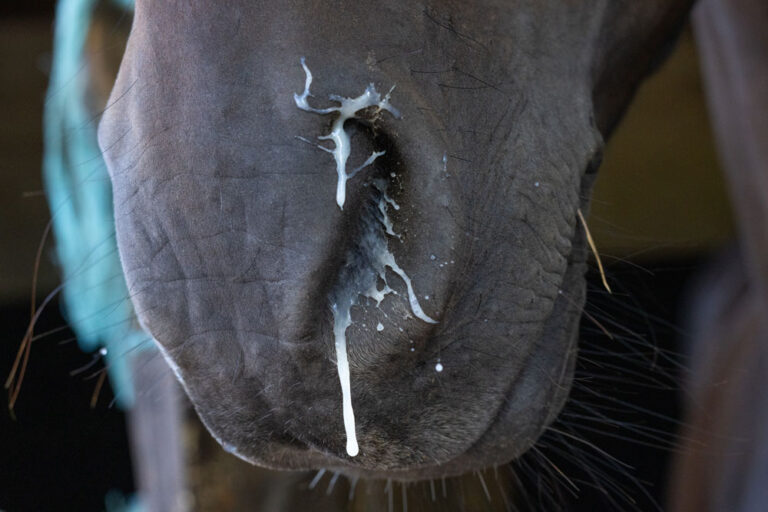
Horses can become infected with the larvae through any break in the skin (trauma, horse fly bite, tick bite, etc.) or at their mucous membranes (eyes, vulva, prepuce, etc.). Therefore, it is essential that the horse owner is diligent in fly protection and observation. If they observe any suspicious lesions, they should contact their veterinarians, State Animal Health Officials, or USDA Area Veterinarian in Charge immediately.
Identification/Notification
If an animal becomes infected by New World screwworm and is left untreated, the animal can die within one week due to secondary infections. Animals identified with myiasis should receive veterinary medical assistance along with collection of larvae within the wound for identification.
If you observe an animal with myiasis, collect the larvae from the lesion and place in a sterile container with 70% ethanol or alcohol and send to the nearest National Animal Health Laboratory Network (NAHLN) lab for diagnosis. Do not place the larvae in formalin.
Treatment
Clean and debride the wound and apply permethrin spray. Ivomec injectable can be given to livestock as a treatment. Also, topical permethrins could be used in horses and other livestock to assist with fly control.
Eradication Techniques
The only proven technique—which worked back in the 1960s—was releasing sterilized male screwworm flies. They mated to the females and rendered their eggs infertile.
More Information
Equine Disease Quarterly offered the following links for more government information about new world screwworms.
- https://www.aphis.usda.gov/sites/default/files/aphis-sop-detection-nws-in-animals.pdf
- https://www.aphis.usda.gov/sites/default/files/factsheet-nws-private-veterinarians.pdf
- https://www.kyagr.com/statevet/disease-prevention.html
(Editor’s note: You can contact the article’s author Beth Johnson, DVM, Director of Regulatory Field Services, Kentucky Department of Agriculture, Office of State Veterinarian, at 109 Corporate Drive, Frankfort, KY 40601; email BethC.Johnson@ky.gov. Equine Disease Quarterly is a publication by the University of Kentucky Department of Veterinary Science, Maxwell H. Gluck Equine Research Center, and is funded by EQUUS/Standardbred Station, Inc. and M&J Insurance.)
Further Content
- Parasites category of articles on MySeniorHorse.com
- Daily Tick Checks on Horses Reduces Risk of Disease. Dr. Nancy S. Loving. MySeniorHorse.com
- Donkeys Expose Companion Horses to Lungworms. Kimberly S. Brown. MySeniorHorse.com
- Tick-Borne Diseases of Concern to U.S. Horses. MySeniorHorse.com
- Equine Insect Repellents for Horses. Dr. Nancy S. Loving. MySeniorHorse.com
- 6 Tips to Decoding a Fly Spray Label. MySeniorHorse.com
- 8 Health Issues for Horses in Summer. MySeniorHorse.com
- Insect Management on a Horse Property. Dr. Nancy S. Loving. MySeniorHorse.com
Sign up for My Senior Horse’s FREE newsletter to get the latest information about equids 15 years and older delivered straight to your inbox!