Reduced rapid eye movement (REM) sleep is associated with impaired learning in many species. In humans, REM sleep helps the brain sort and store daily information into long-term memory. It also plays a key role in emotional health and clear thinking.
Horses must lie down to achieve REM sleep, which can sometimes be challenging for senior horses due to physical pain and psychological factors. For example, degenerative processes such as arthritis or cumulative injuries can cause aches and pains that interfere with good sleep.
Researchers in Finland1 wanted to determine if equine REM sleep behavior was linked to learning. They also wanted to develop a practical learning test that was easy to use in field conditions.
The researchers hypothesized that a low amount of REM sleep was linked to impaired cognitive flexibility. That means if horses had less than normal REM sleep, they would not do as well on the learning test as horses that had sufficient REM sleep.
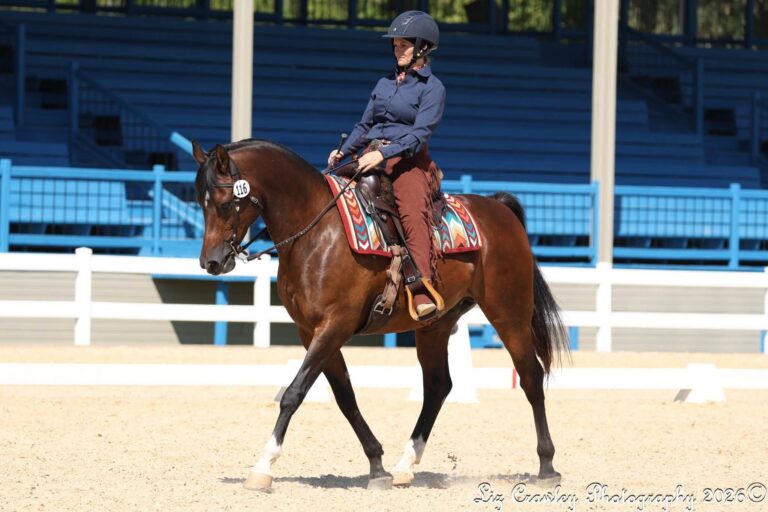
The REM sleep and learning study included 16 riding school horses (14 geldings and two mares). Their age was 15 +/- 1 year. Twelve horses were warmbloods, and three were Finnhorses. The researchers recorded nocturnal REM-like sleep behavior five times for 48 hours over a six-week period.
The Learning Test
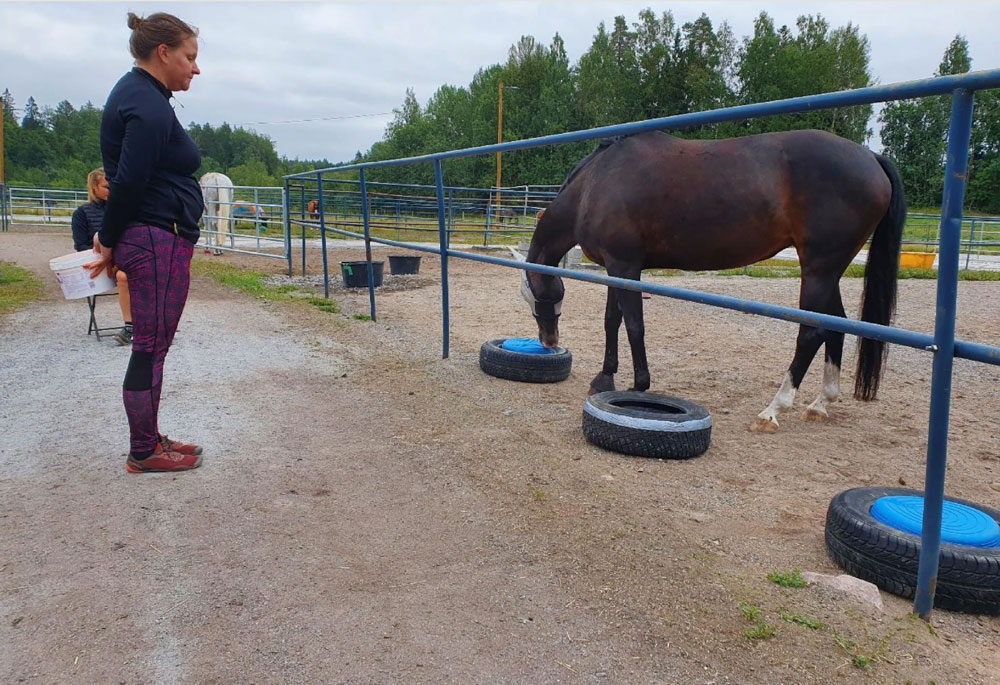
The researchers employed a reversal learning test to measure cognitive flexibility, or an animal’s ability to adapt when the rules of a previously learned task are suddenly switched. This test often is used to evaluate how easily an equine can unlearn an old habit and form a new one.
For example, the horse might learn that choosing a specific object results in a food reward. Once the horse consistently makes the correct choice, the rule is reversed without warning. The previously rewarded choice now yields nothing, while the opposite choice (e.g., the alternate object) becomes correct. Scientists count how many mistakes (errors) and tries (trials) the horse makes before figuring out that the rules have changed.
Studies have shown that horses often struggle with reversal tasks. That means undoing early training or changing unwanted behaviors can be much harder than teaching a brand-new concept.
How Equine REM Sleep Affected Testing
Overall, REM sleep duration was 46.1 +/- 8.7 minutes. Ten horses exhibited REM-like sleep for less than 30 minutes. Six horses exhibited REM-like sleep for at least 30 minutes.
Longer REM sleep was associated with a greater number of successful reversals, while no relationship was found with error rate.
Further analysis revealed differences between short and long REM-like sleep in the probability of moving forward on the test; a 50% chance of a horse moving forward in the test occurring in a median of 5 reversals for horses with less REM-like sleep and in 6 reversals for horses with more REM-like sleep.
Despite differences in the duration of REM-like sleep, all horses except one performed successfully in the reversal learning test and did not show clear differences in their cognitive flexibility.
However, researchers found that horses that quit the reversal learning test themselves—before the end of the rewards or test time—had less REM-like sleep than those that continued until the end of the test or rewards.
They said this is in line with the findings of various other species showing that reduced REM sleep is associated with suboptimal mood, performance deficits, and impaired learning.
“Almost all horses showed signs of frustration during the reversal learning test, but this frustration decreased with each reversal as they learned the task concept,” the researchers noted. “Frustration behaviors were also associated with REM sleep duration; longer REM sleep was linked to a reduced risk of exhibiting frustration.”
Final Words
The researchers developed a method to test horses’ reversal learning ability on-site over a single day. “We found that short REM-like sleep duration without clinical signs of sleep disturbances in horses was associated with poorer performance and lower perseverance during the reversal learning test.”
Reference
- Effect of horse sleep behavior on performance in a field-side spatial reversal learning test. Mira Joanna Hamalainen, Iina Liisa Brotherus, Henna-Kaisa Margareta Wigren, Turire Eriikka Kaimio, Hei Suomala, Anna-Mari Olbricht, Laura Talvikki Hanninen, and Anna Kristina Mykkanen. Scientific Reports. 2026
Related Content
- Horses and the Science of Sleep. Dr. Sue Dyson. MySeniorHorse.com
- My Senior Horse Podcast: Sleep Deprivation. Dr. Amy Polkes. MySeniorHorse.com
- Does My Horse Have Narcolepsy or Sleep Deprivation? Dr. Amy Polkes. MySeniorHorse.com
- My Senior Horse Podcast: Equine Behavior. Dr. Kris Hiney. MySeniorHorse.com
Sign up for My Senior Horse’s FREE newsletter to get the latest information about equids 15 years and older delivered straight to your inbox!