Managing equine weight is difficult for owners. During her recent PhD work from the Atlantic Veterinary College, University of Guelph post-doctoral scholar Megan Ross, in collaboration with Dr. Katrina Merkies et al., collected information that shows the complex decisions horse owners face when managing equine weight.
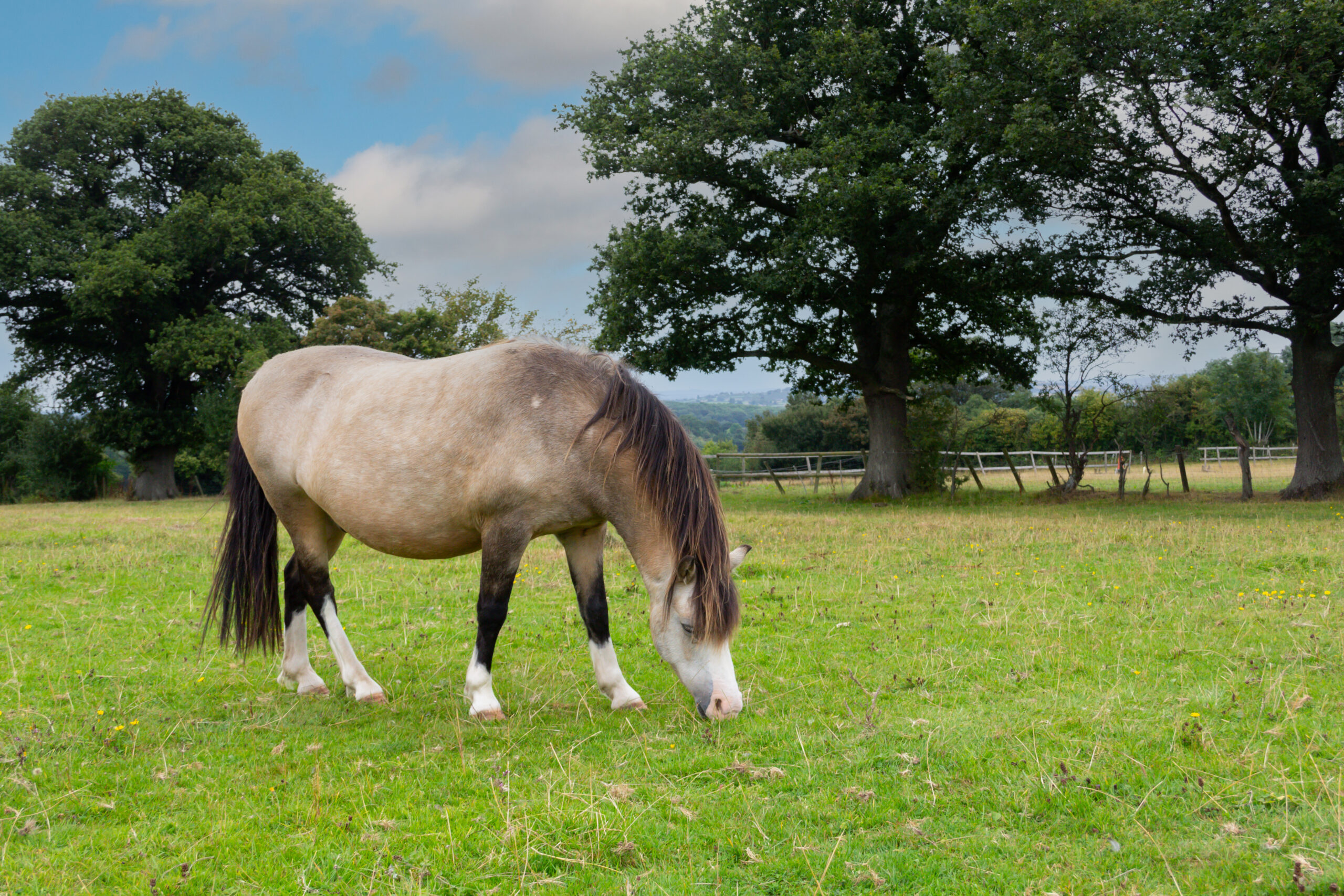
Previous research showed that nearly 29% of Canadian horses are overweight or obese (Kosolofski et al., 2017; Mills et al. 2025). This is a significant welfare concern.
The recent study set out to explore the attitudes, beliefs, and barriers owners encounter when their horses are overweight or obese.
The Battle of the Bulge Is Real
Excess weight in horses isn’t just a cosmetic issue. It can lead to serious health problems such as laminitis, osteoarthritis, and metabolic disorders.
The study found that weight management is far from straightforward. Owners often feel torn between protecting their horse’s physical health and preserving the animal’s mental well-being.
“One of the biggest challenges is that horses thrive on social turnout and grazing, but lush pastures can lead to obesity,” said Ross. “Owners may struggle with the trade-off between keeping horses happy and keeping them healthy.”
Horse Weight and Social Norms
“Overweight horses have been normalized within certain equestrian disciplines and in the media,” said Ross. “When looking at racehorses, eventing horses, or horses that are lean, some tend to think that they’re underweight even when they’re within a healthy weight range.”
The study revealed that cultural norms and even show-ring standards often favor horses that look ‘pleasantly plump.’ This societal pressure can make leaner horses appear underfed, discouraging owners from aiming for an ideal weight.
Traditional practices and resistance to change also play a role, with many owners relying on inherited knowledge rather than evidence-based strategies.
Barriers to Change
Owners cited time constraints, cost, and facility limitations as major hurdles in managing weight. Boarding managers, for example, noted the difficulty of tailoring feed for individual horses in large groups.
Emotional factors were equally influential. Many owners equated a heavier horse with better care, even when they knew a leaner body was healthier.
Ross elaborated on the emotional findings in the study by saying, “Owners often felt torn.” She said owners know a leaner horse is healthier, yet struggle with the discomfort of seeing their horse look thin. “Many keep horses on the heavier side as a sign of good care, and media images that reward overweight horses only reinforce this perception.”
Many horse owners were candid about their preference to have their horses slightly overweight going into winter, with the expectation they will lose weight in harsher conditions and emerge leaner come spring. This belief poses yet another potential risk by owners who underestimate the health risks in overweight horses. These miscalculations can easily lead to chronic health issues like laminitis and metabolic complications.
Horse owners in the study acknowledged that ‘traditional knowledge’ dominates the equine industry, making systemic change difficult. Fear of judgement reinforces the need for effective dissemination of evidence-based education.
Strategies and Struggles
Owners reported exploring a range of weight management strategies, including grazing muzzles and dry lots. They cited concerns about boredom, frustration, and overall welfare.
Some participants worried about incorrect use of grazing muzzles or the lack of enrichment in dry lots, which can lead to stress.
Frustrated by strategies that weren’t working, one participant reported turning to U.K. resources and ultimately implementing a track system. Track systems are an innovative approach designed to encourage horses to move more by mimicking how they would travel for resources in natural environments, thereby providing both exercise and enrichment. This system has proven successful and is more broadly utilized in the U.K. and some other countries. It is less common in Canada.
Interestingly, slow-feeding systems—which research shows can reduce stress and overeating—were rarely mentioned by interview participants even though studies suggest horses prefer them over scheduled feeding.
Ross emphasized that practical, welfare-friendly solutions are essential. Strategies must balance physical health with mental well-being. Owners need support in finding approaches that fit their facilities, budgets, and values.
Next Steps: Collaboration for Change
Ross advocates for collaboration between equine science and social science to shift societal norms and improve knowledge transfer.
“We need to make healthy weight the new normal,” she said. “That means supporting owners through the discomfort of seeing horses that look leaner than they’re used to and helping them shift their paradigm. It starts with us—working with owners, industry, and researchers to create practical tools and supportive environments.”
Body Condition Scoring
While body condition scoring (BCS) wasn’t part of the survey questions for this study, it played a key role in selecting participants. As part of a separate study, a veterinarian assessed horses using the Henneke BCS system (Mills et al. 2025). Horse owners with horses classified as overweight or obese were purposively invited to take part in the interviews.
Literature cited in the final paper mentions that owners often misinterpret fat vs. muscle and struggle with BCS accuracy. Possible future directions for BCS tools include creating a database of real horse images across breeds to improve scoring tools.
More awareness of the body condition scoring systems and their practical implementation will support societal shifts toward recognizing, accepting, and reducing judgement around horses within a healthy weight range.
Body condition scoring is an activity that requires much practice. TheHorsePortal.ca offers online courses in Body Condition Scoring. This is one method to help owners gain confidence in regularly assessing their horses’ body condition so they can be proactive in weight management strategies.
There is also a free interactive Body Condition Scoring tool.
You can watch video interview excerpts with researcher Megan Ross in the video below.
References
- The Effect of Benchmarking on Equine Management Practices and Horse Welfare on Prince Edward Island, Canada. Animal – Open Space (2025). Mills, M.; Proudfoot, K.; Elsohaby, I., Burns, J.;Ross, M., McKenna, S.; Ritter, C.; and MacMillan, K.
- ‘It’s more emotionally based’: Prince Edward Island horse owner perspectives of horse weight management. Animal Welfare (2024). Ross, M.; Proudfoot, K.; Campbell Nishimura, E.; Morabito, E.; Merkies, K.; Mitchell, J.; and Ritter, C. 33, e14, 1-11.
- Brief communication: Communication brève. The Canadian Veterinary Journal (2017). Kosolofski, H. R.; Gow, S. P.; and Robinson, K. A.
Further Reading
- Body Condition Scoring: Body Condition and Other Techniques. Sarah Nelson. MySeniorHorse.com
- A Guide to Equine Body Condition Scoring. Sarah Nelson. MySeniorHorse.com
- Donkey Body Condition Score. Dr. Faith Burden. MySeniorHorse.com
Sign up for My Senior Horse’s FREE newsletter to get the latest information about equids 15 years and older delivered straight to your inbox!