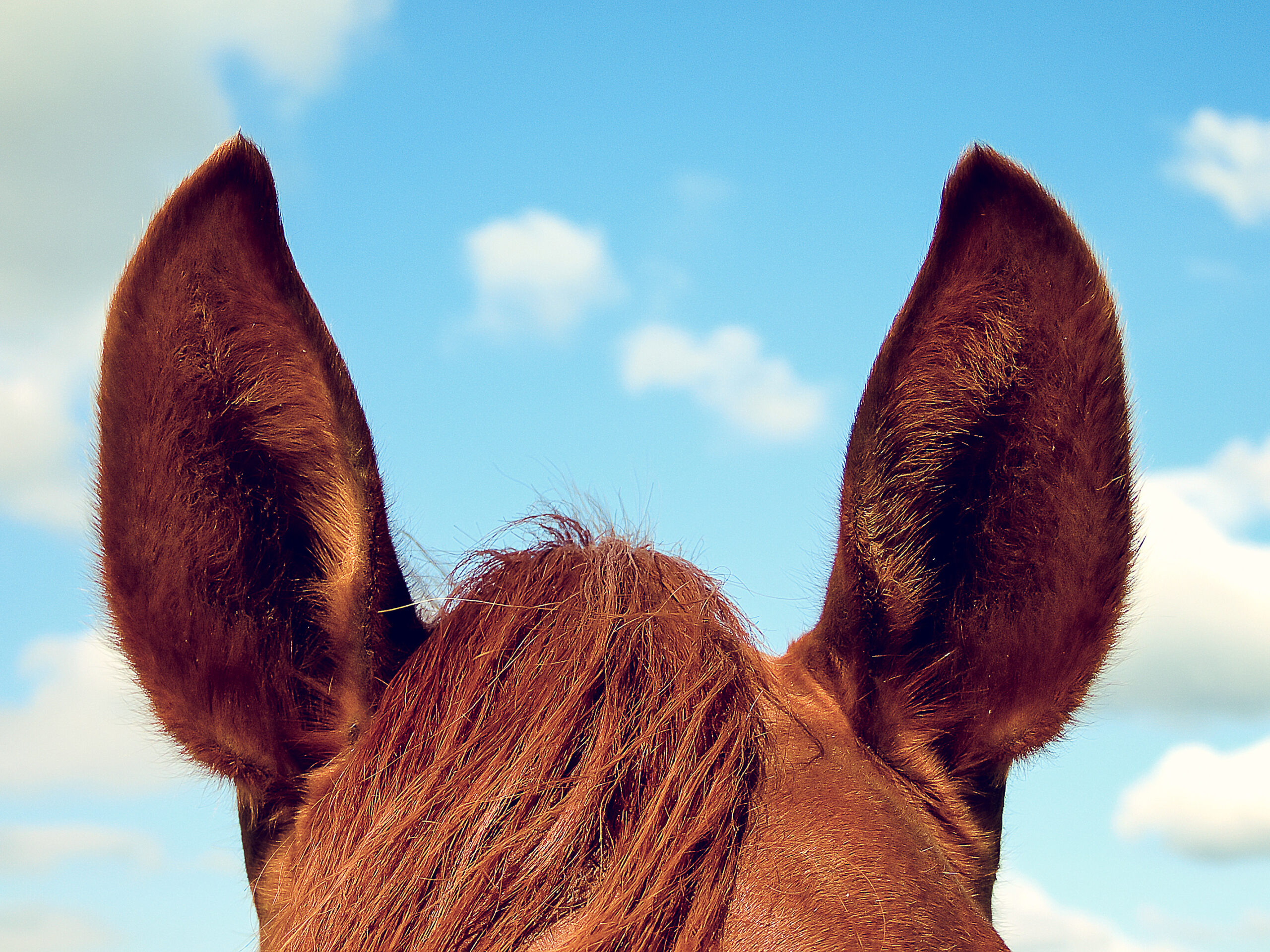
The sense of hearing is extremely important for horses. They evolved as prey animals, so they need to know about the presence of potential predators. The ability to move their ears in many directions and the shape of the ears are vital to capture and concentrate sound.
Ears and Emotions
Not only do horses use their ears to hear, but they also use them as a method of non-verbal communication with other horses and people. Failure to recognize how horses perform a lot of communication between each other and with us by facial expressions and movements of the head and neck means potential failure to be aware of a horse’s emotional state.
A horse’s emotional state tells us something about its well-being. It is not normal for a horse to stand at the back of a stable with the ears back and not engage with stimuli in the environment, for example the sound of a food bucket. We need to observe, be curious, and ask why. Is the cause pain, chronic stress, or something else?
Horse Hearing
Much less is known about the hearing of horses compared to people. For example, we do not know whether hearing ability declines with age in horses. There does appear to be some variation in auditory acuity and/or reactivity to sound, but how much this relates to the horse’s state of arousal versus actual ability to hear is difficult to determine.
There is little doubt that horses do react to the tone and volume of voice used by a handler in conjunction with the handler’s posture. This will be reflected by a horse’s behavioural responses.
Deafness in Horses
We also know that some horses are deaf. We can test this subjectively by making a sudden loud noise, such as clapping hands together, assuming that the horse is not startled by the sight of the movement of hands. It would be expected that a horse would react by altering its head position and movement of the ears.
The ability to hear can also be assessed objectively by measuring what are called brainstem auditory evoked responses. A study from the University of California, Davis1 demonstrated several causes of deafness in horses.
There are some horses with certain eye and coat colors that have congenital (present at birth) deafness. Deafness can develop secondary to specific conditions, such as otitis media or interna (inflammation of the middle or inner ear), temporohyoid osteopathy (bony proliferation involving the joints between the hyoid bone and the temporal bone, which is part of the skull), or more rarely multifocal brain disease. However, none of these are common conditions.
Beyond Our Hearing
It is important to be aware that horses can hear sounds that we cannot hear. So, if a horse reacts unexpectedly, it might be because it has heard something of which we are unaware.
This could explain why some horses are apparently hyper-reactive to the noise of clippers because they emit several bands of high frequency (ultrasonic) sounds. However, with progressive reward-based training, horses often can relatively easily become habituated to the noise of clippers.
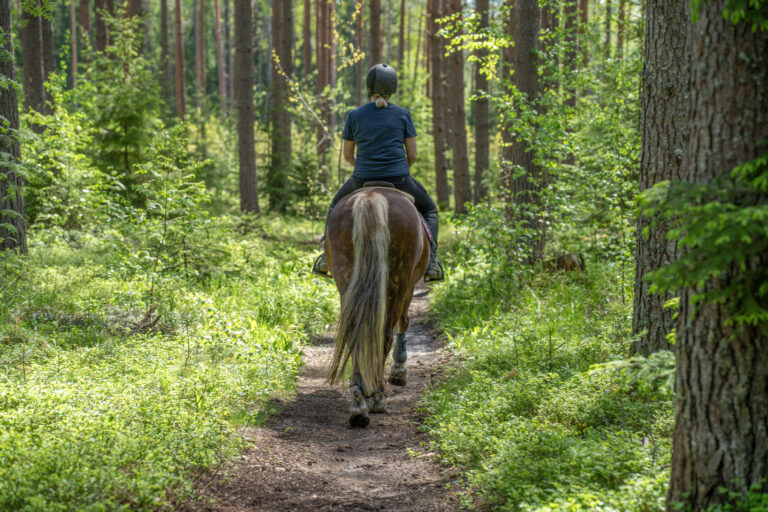
If a horse suddenly stops while you are riding along a trail, it might have heard a noise that you have not. Give the horse the benefit of the doubt. Allow it time to listen, then ask it to move forward again.
Responses to Sounds
A recent study looked at behavioral responses to a variety of sounds and changes in heart rate.2 The sounds included repeated whinnying, applause (a crowd clapping and cheering), trotting on a hard surface, music (We are the Champions, by Queen, often played in prize-giving ceremonies), and feed (nuts/pellets being scooped into a bowl).
For every sound, the peak heart rate response was significantly greater than the resting heart rate, reflecting that the horses were responsive to the sounds.
Trotting elicited the greatest response. The ears flicking back and forth was a frequent behavioral response to all sounds. Stepping away from the direction of the auditory stimulus and raising the tail were relatively overrepresented as a response to the trotting sound.
Exploratory behavior—the horse lowering its head and neck and sniffing parts of the stable—was relatively underrepresented in response to trotting but overrepresented in response to applause and music. Vocalizations were frequent in response to whinnying compared with the other sounds.
Clearly, the horses were differentiating between the sounds.
The reasons for the different responses might be multifactorial. It might have had previous exposure to the sound. The horse might not know the source of the trotting sound and be concerned about where another horse might have been. There could be a possible calming effect of music.
However, in the real world, often there is an interaction between sound and other environmental factors. These must be considered when assessing a horse’s behavioral responses. Bear in mind that the ears are used for both hearing and communication.
Horses and the Science of Harmony Bonus Video
You can watch ‘Horses and the Science of Hearing’ in the player below or on YouTube. See Further Content to watch videos and read about other topics in the ‘Horses and the Science’ series.
References
- Brainstem auditory evoked responses in an equine patient population: Part 1 – Adult horses. Aleman, M.; Holliday, T.; Nieto, J.; Williams, D. J. Vet. Int. Med. 2014; 28, 1310-1317.
- Equine behavioural and physiological responses to auditory stimuli in the presence and absence of noise-damping ear covers. Hole, C.; Murray, R.; Marlin, D.; Freeman, P. Animals 2023; 13, 1574.
Further Content
- My Senior Horse Podcast: Horses and the Science of Harmony. Dr. Sue Dyson. MySeniorHorse.com
- Horses and the Science of Harmony. Dr. Sue Dyson with Padma Video. MySeniorHorse.com
- Horses and the Science of Sleep. Dr. Sue Dyson with Padma Video. MySeniorHorse.com
- Horses and the Science of Contentment. Dr. Sue Dyson with Padma Video. MySeniorHorse.com
- My Senior Horse Podcast: Equine Behavior. Dr. Kris Hiney. MySeniorHorse.com
- My Senior Horse Podcast: Positive Reinforcement. Dr. Eleanor Girgis. MySeniorHorse.com
- Horse Hearing, What You Should Know. MySeniorHorse.com
- Horse Hearing: What Owners Should Know. Heather Lewis, AIA, NCARB, AAA. MySeniorHorse.com
Sign up for My Senior Horse’s FREE newsletter to get the latest information about equids 15 years and older delivered straight to your inbox!