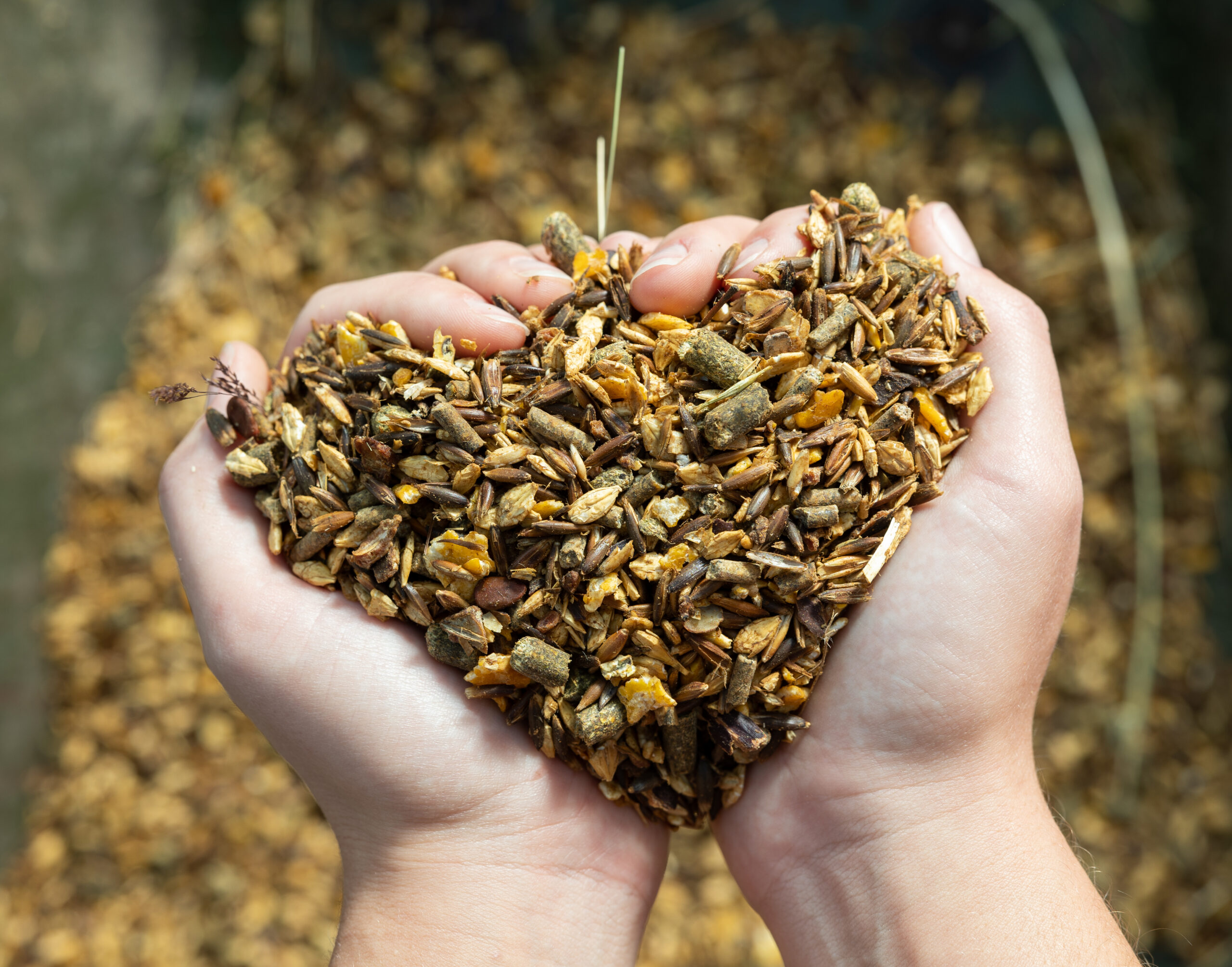
Ever get confused by the many types of horse feeds on offer? There are so many concentrate feeds (also known as compound/bucket/hard feeds—basically those we feed alongside forage) available, it can be hard to know which one to choose. Here we look at some common categories to help explain what’s what and things to look for to help you make the right decisions for your horse.
Feed Balancers
Balancers are small, nutrient-dense feeds—usually pellets—formulated to provide a concentrated supply of vitamins, minerals, and amino acids. Designed to be fed in small amounts, typically 500 grams per day for a 500-kilogram horse, balancers provide negligible amounts of energy (calories), starch, and sugar per daily serving, often making them an ideal choice for good doers. You can buy balancers specifically suited to all ages, types, and workloads as well as formulated for their specific forage.
Although many horses and ponies maintain weight easily on forage alone, forage-only diets can be lacking in key nutrients, including copper, zinc, selenium, vitamin E, and lysine—an essential amino acid or “building block” of protein that plays an important role in supporting muscle health. Balancers are formulated to provide the nutrients lacking in forage diets, particularly important for those on restricted forage rations, such as soaked hay. They’re also a useful way of topping up vitamin and mineral intake in horses fed less than the recommended amount of concentrate feed or feeds without added vitamins and minerals.
Another option are vitamin and mineral supplements. These are often powders (sometimes pelleted) fed in tiny amounts (usually 50-150 grams per day), and they can also balance the diet of a horse or pony on forage only. Unlike balancers, they typically don’t provide high levels of amino acids. Where balancers can be fed on their own (although they are often fed alongside a chaff), vitamin and mineral supplements must be mixed into a small amount of another feed.
Read More: Feeding Older Horses That Are Easy Keepers
Senior Feeds
Senior feeds are carefully formulated with the additional needs of aging horses in mind. They may contain higher levels of specific nutrients to support immune or respiratory health and generally include higher protein levels to help seniors maintain muscle mass. Some might also contain functional ingredients to support joint or digestive health. Just because a senior horse is aging well and doesn’t need extra calories or is retired from work, that shouldn’t mean the quality of their diet should be compromised. Always choose a feed appropriate to a horse’s body condition, and ensure their nutritional needs are met.
Like young poor doers, seniors who struggle to maintain a healthy weight have increased calorie requirements. While senior-specific feeds might be the best choice for your veteran, don’t rule out other appropriate conditioning feeds.
Overweight seniors, or those prone to gaining weight easily, do not need higher-calorie senior feeds but often still require increased nutrition to support the body as they age. Senior science has shown overweight horses are at increased risk of metabolic disorders, amongst other concerns. Regardless of age or health status, excess weight should be avoided. This is especially important for senior horses, which might be more prone to stiffness and arthritis as they age.
Senior feeds are often made with smaller particle sizes to make them easier for aging teeth to chew; mashes are common options within this category too. See the forage replacer section below if your horse is struggling to chew.
Performance Feeds
Performance feeds are generally designed to provide horses with the higher level of energy (calories) needed for a harder-working lifestyle. They contain more quality protein than low-energy feeds to support muscle health, function, and recovery. Increased nutrients support the immune and respiratory systems, which might be under greater stress, and many will include ingredients to support optimal digestive function. A few other things to note:
- Performance feeds are generally ideal for horses in medium to hard work.
- Those frequently competing and training at a lower level might also require higher nutritional support.
- Hard-working Pony Club mounts and those competing in a wide range of sports might also need increased energy and/or nutrients.
- Hunters, team chasers, and endurance horses also fit into the performance horse category.
With many seniors still actively competing, you may not want to completely rule these feeds out as options for your golden oldie, although try to avoid the higher-starch options that aren’t ideal for seniors.
Conditioning Feeds
The term “condition” can mean different things to different people, so it’s important to make the distinction between muscle and fat. To some people, condition means general appearance, including topline, skin, coat, and hoof health. When it comes to diet, condition simply means fat coverage, and conditioning feeds are higher in calories to help poor doers or harder-working horses maintain a healthy body weight. Most conditioning feeds will also contain high levels of quality protein to support topline development.
Calories are a measurement of energy, expressed on food labels in human nutrition. In the UK, energy in horse feed is expressed in “MJ DE”—megajoules of digestible energy. In the U.S., it’s “Mcal DE,” or megacalories. Nutritionists often use the word calories when talking to horse owners because it’s a term we all recognise when discussing bodyweight. As horse owners, we often refer to energy as the way a horse behaves or performs and think of high-energy feeds as heating or making horses more “energetic.” This can cause confusion because regardless of your horse’s behaviour, if they are underweight, they need more energy (calories) to help them gain weight.
The types of energy sources in the feed recipe are key here. Horse digest various food ingredients (e.g., cereal grains, fibres, oil) differently. This can have an impact on both a horse’s health and behaviour, so it’s worth learning more if you’re unsure where to start.
We often use the term “poor doer” to describe horses and ponies that lose weight easily and/or struggle to maintain it. Although certain breeds such as Thoroughbreds are renowned for being poor doers, this is not always the case. Every horse or pony is an individual; some ponies and native breeds can struggle to maintain weight too.
Read More: Energy-Producing Nutrients
Read More: Feeding Senior Horses That Are Hard Keepers
Complete Feeds and Forage Replacers
For senior horses losing weight even on large amounts of hard feed, our first recommendation would be to check that they’ve had their teeth examined recently. Even mild dental discomfort can reduce appetite and slow chewing rates, leading to loose droppings and/or a reduction in food absorption, amongst other things. These can happen well before a horse shows clear signs of quidding, or dropping food.
Speak to your vet if you’re concerned your horse is underweight to rule out any potential health problems, particularly if weight loss is sudden. Don’t forget to check that worming strategies are up to date too. Assuming your horse is healthy, if they’re eating large amounts of concentrate feed and still losing weight, it’s possible they are simply not eating enough forage and/or grass. Take time to monitor how much they are eating; it can be easy to overlook just how much food is being wasted.
Forage replacers are ideal for horses that can no longer consume enough long-stem fibre or forage to maintain a healthy weight or those that need a very carefully controlled low-sugar/grass-free diet. For some horses, even short-chopped fibres are no longer feasible, so choose options most suited to your individual horse. Typically, forage replacers replace forage like for like. For example, 1 kg of forage replacer (dry weight) replaces 1 kg of forage.
Read More: Forage Substitutes
Read More: Feeding Senior Horses With Dental Issues
Extra Tips
Energy or calorie requirements will vary considerably between individuals. Some horses in very hard work may need little concentrate feed if they have plenty of good-quality forage and/or grazing.
Many concentrate feeds are formulated to be fed at the same feeding rate regardless of “category” to supply a balanced diet (e.g., 3 kg/day for a 500 kg horse). Should a horse or pony not require the full recommended amount, they’ll experience a shortfall of vitamins and minerals. A balancer or vitamin and mineral supplement can help ensure the diet is still balanced.
Finally, do make sure the feed you choose is suitable for any health condition your horse may have. And don’t forget, if you’d like help and support along the way, reach out to a feed advisor or nutritionist for support to help your horse thrive.
Related Reading
- When Should You Start Feeding Your Horse Senior Feed?
- Understanding Ration Balancers for Senior Horses
- Feeding Senior Horses According to Their Dental Health
Sign up for My Senior Horse’s FREE newsletter to get the latest information about equids 15 years and older delivered straight to your inbox!
-
View all posts
Vanessa Allen is a nutritional content manager at Spillers. She is responsible for translating Spillers’ nutritional knowledge into educational content. Vanessa has been with Spillers for over a decade, providing nutrition consultations direct to horse owners and professionals. Riding before she could walk, Vanessa has spent lifetime working with horses in practical and scientific roles and has a wealth of knowledge to share with horse owners.